5.25.2011

TRMM Satellite picks up Joplin tornado


Our colleague and occasional guest poster Kyle Meng points out that NASA's TRMM satellite (previously here) passed over the supercell that generated this past weekend's megatornado in Joplin, MO, generating a map of the resultant precipitation. You can find out about it here.

5.24.2011

WeatherSpark


WeatherSpark combines two of our favorite topics (data visualization and climate/weather) in one very compelling package. A few quick and interesting things to do with it in under 5 minutes:
  1. Check out predicted cyclicality of temperatures over the 24 hour cycle
  2. Note the difference between observed weather (black line in the past) versus predicted
  3. Check out weather at different physical locations (close to / far from coast; east of / west of mountains; north / south; etc.)
  4. Play around with the other, less intuitive variables (pressure, humidity...)
  5. Do 1. 2. and 3. together to detect rural vs. urban heat island effects (particularly cool)
Enjoy!

5.23.2011

Data-oriented search engine

Jon Goldhill sent me a link to his company's new data-oriented search engine, which I think has interesting potential: zanran.com

According to their website:


What is Zanran?
Zanran helps you to find ‘semi-structured’ data on the web. This is the numerical data that people have presented as graphs and tables and charts. For example, the data could be a graph in a PDF report, or a table in an Excel spreadsheet, or a barchart shown as an image in an HTML page. This huge amount of information can be difficult to find using conventional search engines, which are focused primarily on finding text rather than graphs, tables and bar charts.


Put more simply: Zanran is Google for data.


How it works… technology overview
Zanran doesn't work by spotting wording in the text and looking for images – it's the other way round. The system examines millions of images and decides for each one whether it's a graph, chart or table – whether it has numerical content.
The core technology is patented computer vision algorithms that decide whether an image is numerical – and they're accurate (about 98%). But the huge majority of images on the internet are not graphs etc. So even though the accuracy is high, you will still get some non-numerical images.
In comparison, looking for tables is relatively simple. Once we've found a table we then have to decide whether it's essentially numerical - and we have algorithms for that.
Our programmes then take suitable text near that image and build the search engine around that text. At present, we extract tables and images from HTML, PDF and Excel files and will be processing PowerPoint and Word documents in the near future.


I've added a link on our resources page. Check it out.

5.16.2011

Columbia University's Sustainable Development PhD Graduates of 2011!

On Saturday, six of us from Columbia University's PhD program in Sustainable Development graduated amid great fanfare. In reverse alphabetical order (since Ram got to walk across the stage first):

Marta Vicarelli wrote the dissertation "Essays on Climate Risks and Vulnerability-Reduction Strategies" and will be an Assistant Professor of Economics at University of Massachusetts Amherst following a Postdoc at Yale University.

Anisa Khadem Nwachuku wrote the dissertation "Critiquing Economic Frameworks in Sustainable Development: Health Equity, Resource Management and Materialism" and is working for McKinsey & Company.

Gordon McCord wrote the dissertation "Essays on Malaria, Environment and Society" and will be an Assistant Professor at the School of International Relations & Pacific Studies at University of California San Diego.

Chandra Kiran Krishnamurthy wrote the dissertation "Essays on Climatic Extremes, Agriculture and Natural Resources" and will be a Postdoc at UmeÃ¥ University of Sweden.

Solomon Hsiang wrote the dissertation "Essays on the Social Impacts of Climate" and will be a Postdoc at Princeton University.

Mukul Ram Fishman wrote the dissertation "Theoretical and Applied Dimensions of Natural Resource Management" and will be a Postdoc at Harvard University.

Jump if you're a doctor!

5.14.2011

Are Temperature and Incentives Compliments or Substitutes? Evidence from 1947

Here's another gem from the lab of Norman Mackworth (which in my head is looking increasingly like the Dharma Initiative): "High Incentives Versus Hot and Humid Atmospheres in a Physical Effort Task" N. H. Mackworth (British Journal of Psychology, 1947).  The setup is very similar to my last post, except this time the workers are doing arm curls until complete exhaustion:


But Mackworth varied whether the worker was encouraged to push themselves to do more (verbally and visually).  In all cases, the workers with encouragement did more arm curls.  But at high temperatures, this margin dropped substantially (see fig). In this case, it seems like moderate temperatures and incentives are compliments.  This sounds like unfortunate news for hot developing countries...

[For a review of what's happened since 1947 in this field of ergonomics, see the book chapter here.]

5.13.2011

Which health supplements actually work?


Since we're pretty big on data visualization here on Fight Entropy I thought I'd point out that the guys over at Information is Beautiful have updated their great Snake Oil infographic on nutritional supplements. It does an excellent job of summarizing the current state of research on a fairly sprawling and contentious topic. Go check it out.

Now if they'd only do one on climate phenomena...

5.12.2011

Are Temperature and Human Capital Compliments or Substitutes? Evidence from 1946

My own work has focused on whether economic productivity can be influence by temperature through its impact on worker productivity. I recently dug up "Effects of Heat on Wireless Telegraphy Operators Hearing and Recording Morse Messages" by N. H. Mackworth (British Journal of Industrial Medicine, 1946) and have decided its one of my favorite papers. The British military asked Norman Mackworth to put Morse code operators in rooms of varying temperature and humidity and recorded the number of errors they made. These guys were put to work in 3 hour stretches, decoding random sequences of letters and numbers for 5-7 weeks (see fig).  

The main result is stark.  The operators who were considered "exceptionally skilled" (based on their error rates at low temperatures) were hardly affected by the heat. But the less skilled operators had error rates that went through the roof when temperatures rose (see below). Apparently, moderate temperatures and human capital are substitutes (at least in this situation). This is good news for many of the hot, developing countries around the world...

5.10.2011

How important is brain temperature? Ask a large predator fish

This is the kind of thing I can't believe they didn't teach me in elementary school.  I knew the platypus was exceptional among mammals for its beak and eggs, but I never knew that some cold-blooded animals (ectotherms) were actually partially warm-blooded (regional endothermy is the technical name). 

I was doing a literature review of the effects of temperature on brain function and cognition, when I ran across this amazing literature. In a famous 1982 Science article, Francis Carey of WHOI demonstrated that swordfish had evolved a specialized organ that simply sat next to their brain and kept it warm by burning calories quickly.  This was important, he argued, because these fish rapidly dove to depths where the water temperature was 20 degrees (C) colder than their normal environment. Because brain function is important to these hunters, it seemed reasonable that it was worth it for them to evolve specialized organs to keep their brains warm.


Sound too fantastic? Since then, cranial endothermy has also been documented in some varieties of sharks and tuna.  Because these species are so far from one another (in an evolutionary sense) and many of their more closely related relatives didn't have brain heaters, its thought that these different groups evolved similar organs independently from one another. This would suggest that maintaining a relatively more stable brain temperature might have large benefits.  Now, does this apply to humans?...

5.08.2011

Temper and Temperature in Major League Baseball

Another recent (slightly amusing but) good one from Psychological Science. (Related here and here).

Temper, Temperature, and Temptation
Heat-Related Retaliation in Baseball
Richard P. Larrick, Thomas A. Timmerman, Andrew M. Carton and Jason Abrevaya

Abstract: In this study, we analyzed data from 57,293 Major League Baseball games to test whether high temperatures interact with provocation to increase the likelihood that batters will be hit by a pitch. Controlling for a number of other variables, we conducted analyses showing that the probability of a pitcher hitting a batter increases sharply at high temperatures when more of the pitcher’s teammates have been hit by the opposing team earlier in the game. We suggest that high temperatures increase retaliation by increasing hostile attributions when teammates are hit by a pitch and by lowering inhibitions against retaliation.


5.06.2011

Seriously?

This came out in March in the journal Psychological Science.  My amazement is with the people in the study (not the people doing it).

Local Warming Daily Temperature Change Influences Belief in Global Warming

Ye Li, Eric J. Johnson
Center for Decision Sciences, Columbia University

Lisa Zaval
Psychology Department, Columbia University

Abstract: Although people are quite aware of global warming, their beliefs about it may be malleable; specifically, their beliefs may be constructed in response to questions about global warming. Beliefs may reflect irrelevant but salient information, such as the current day’s temperature. This replacement of a more complex, less easily accessed judgment with a simple, more accessible one is known as attribute substitution. In three studies, we asked residents of the United States and Australia to report their opinions about global warming and whether the temperature on the day of the study was warmer or cooler than usual. Respondents who thought that day was warmer than usual believed more in and had greater concern about global warming than did respondents who thought that day was colder than usual. They also donated more money to a global-warming charity if they thought that day seemed warmer than usual. We used instrumental variable regression to rule out some alternative explanations.

5.03.2011

Al Gore's "Our Choice" app

By chance, I ran across across Al Gore's new high profile ipad/iphone app. Its a new kind of ebook (which presents the material from his paper book with the same title) where interactive graphics, maps, movies and data visualizations are all embedded in the text.  After browsing it for just a few minutes, it becomes clear that it deserves the praise it's been getting for its innovation in design (regardless of whether or not you agree with its message).  For complex multidimensional problems, like global climate change, getting an average person up to speed on the issues is costly.  Design like this can help reduce this cost and get more people involved in the discussion in a meaningful way.  For someone who wants a rapid and concise intro to the issues [and is willing to tolerate a few subjective/political interpretations of the issues], this is a fun way to go.  You can download it here for $5. Trailer videos below.


4.29.2011

May 6th-7th, 2011: Interdisciplinary Ph.D. Workshop in Sustainable Development

LICRICE model for the global
distribution of tropical cyclone winds
Event Announcement:

Interdisciplinary Ph.D. Workshop in Sustainable Development
May 6th-7th, 2011: Columbia University in the City of New York, USA

The Ph.D. students in Sustainable Development at Columbia University are convening the first Interdisciplinary Ph.D. Workshop in Sustainable Development (IPWSD); scheduled for May 6th-7th, 2011, at Columbia Universityin New York City.  The IPWSD is a conference open to graduate students (both Masters and Ph.D.) working on or interested in issues related to sustainable development.  It is intended to provide a forum to present and discuss research in an informal setting, as well as to meet and interact with similar graduate student researchers from other institutions.

The IPWSD schedule includes sessions by 35 speakers from institutions across the US, Europe and several other countries who will be giving talks on issues of sustainable development from a diverse range of disciplinary backgrounds, including economics, environmental science, engineering, psychology, sociology, law, and others. There will also be an introductory talk on Friday, May 6th,  by Professor Jeffrey Sachs, Director of the Earth Institute, and a panel discussion on "Climate Policy in the Face of a Catastrophe" with professor Scott Barrett, professor Mark Cane, and Andrew Revkin, editor of the "Dot Earth" blog for the New York Times.

For further details on the  Interdisciplinary Ph.D. Workshop in Sustainable Development (IPWSD) please refer to our:

Homepage: http://blogs.cuit.columbia.edu/sdds/schedule-events/ipwsd/

Program/Schedule: http://blogs.cuit.columbia.edu/sdds/schedule-events/ipwsd/program

To attend, please RSVP to: cu.sdds.ipwsd@gmail.com by Wednesday, May 4th.

4.25.2011

TRMM Satellite Data


Our colleague Amir points us to the great tropical precipitation data coming out of the Tropical Rainfall Measuring Mission Satellite. Lots of (tropical) rainfall and storm data, including for big events like cyclones, going back to 1998.

Also worth checking out, and going up on the student resources page shortly, is their very nice little Q&A on climate and weather, here.

4.23.2011

Mapping World Bank funds

Anisa found this one:  The World Bank has made data on all its projects available.  They've even made a nice GUI for exploring it all: maps.worldbank.org.


Click on a country and you can see descriptions of individual projects. 
Prior to the Spring Meetings 2011, Mapping for Results has identified more than 1250 active Bank financed activities working in 16,520 locations. These activities are a subset of more than 2,500 active financed Bank activities with a volume of more than $160 billion.

4.20.2011

Karlan and Appel's "More Than Good Intentions"


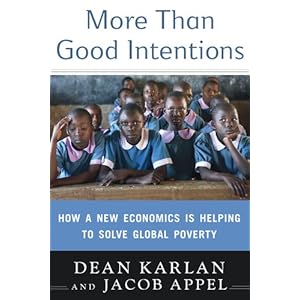
Dean Karlan and Jacob Appel's new book More Than Good Intentions (previously mentioned here) is coming out tomorrow and Sol and I got a hold of review copies. To that end, a review:

Overall it's a great read. Karlan does behavioral development economics with a big emphasis on Poverty Action Lab-style randomized control trials, and the book is essentially a thematicized overview of the current state of that field. What's particularly worth noting is that behavioral development econ is very new: most of the papers and studies covered are from the last ten years (Googling around a bit turns up what I think is the earliest lit review from 2006), and as far as I can tell this is the first book on the subject at all.

That newness shows up in the general slant of the book. A lot of general-audience econ and science books tend towards pithy summaries of major results from the author's area of research (e.g., "libertarian paternalism works" or "clever identification can reveal crazy facts"). But the pithy summary of this book would probably be something like "psychology really affects economic outcomes in developing contexts, sometimes hugely, and here's some promising early evidence." There's less a grand thesis that's being hammered away at so much as a constellation of interesting data points all hinting at a new and interesting way to think about the fundamental problems of development.

Some of those seem very promising. The multiple sections on microfinance provide a lot of worthwhile food for thought, and Karlan & Appel's emphasis on the importance of providing microsavings as opposed to simply microcredit is particularly welcome. Other parts of the book on areas like agriculture, health, etc. seem to me almost as if they should be "behavioral" chapters in books on those subjects, which really is another way of saying that the field is young and there's a lot of research waiting to be done.

In short, the book was fun, engaging, and a quick read, and in combination with some background texts could probably could sub out for a nice undergrad class on behavioral development economics. I'd especially recommend it to high school and college students who are interested in development and trying to get oriented in the field / find out who the major players are / figure out which open problems are juiciest.

4.19.2011

Kenneth Arrow on climate change and how times have changed

Sol and I had the good fortune to hear Kenneth Arrow speak last week. In addition to being one of the most famous economists ever (see Arrow-Debreu, Arrow's Impossibility Theorem, etc.) Arrow has a special place in our hearts because he spent part of his early career in climatology, specifically doing weather forecasting for the US military during World War II. Which leads us to my favorite quote from last week's seminar, which was really more of an aside:
"I was a meteorologist as my military service during World War II, and we were TAUGHT that carbon dioxide was going to make the world warmer."
Like I always say: the simple reason why CO2 warms the climate has been known for over 150 years. It was uncontroversial until it implied that we needed to change our lifestyles.

*Update: for more fun from Ken Arrow, see this Andrew Gelman's post on Arrow's Other Theorem ("any result can only be published at most five times").

4.16.2011

Even pirates need contracts

My advisor, Bentley MacLeod, has successfully convinced me that incomplete contracts are a central problem in both environment and development economics.  In both situations, there are a large number of complex phenomena that are difficult to specify in advance. This makes it difficult to write contracts describing future contingencies, leading to incomplete contracts and market failures.


I came across this story by NPR, a nice example of how important complete contracts are: Somali pirates are writing increasingly complex contracts with one another. Here are the highlights:
Ransoms now average between $4 million and $5 million, and researchers estimate as many as 2,000 pirates operate from Somalia's shores. 
Law enforcement sources say the larger pirate syndicates are becoming increasingly sophisticated and professional. Last year, the coast guard in the Seychelles, an island nation in the Indian Ocean, found an 11-page, handwritten piracy contract in a seized skiff. Like many business ventures, the contract outlined everything from division of profits to an employee code of conduct. 
I would love to know the rate of return for lending capital to pirates:
Wayne Miller, a former police officer from Australia, spent last year teaching the Seychelles' police how to interrogate pirates. Miller has seen the contract and said it divided ransom money into shares based on investors' contributions to the operation. 
"If they provided AK-47s or RPGs [rocket-propelled grenade launchers] or fuel, even the skiffs and mother ship, they were given a certain share that was quite high, and that ensured that whatever was made, the bulk would come back to them," Miller said.
 And don't forget your risk premium:
Miller said ransom shares for pirate workers were divided between those who did the more dangerous jobs — hijacking on the sea — and those who did the safer tasks on land. 
"Shares on land would relate to taking care of hostages once they were taken ashore," Miller said in an interview in Somaliland, an autonomous region of Somalia. "We noticed that the biggest share went to one particular person, and my assumption is that would be the negotiator." 
... or some basic institutions to ensure the rest of the rules are followed...
The contract even outlined a pirate code of conduct. Pirates could not fight and had to obey the captain's orders. If they broke the code, they forfeited shares. But the contract was not all stick. 
"What was striking were bonuses for being first on board another ship," said Miller.In fact, piracy researchers say the first on board can sometimes win a Toyota Land Cruiser.

4.11.2011

ARV recovery video

Sol and I are both reading Dean Karlan and Jacob Appel's new book More Than Good Intentions these days. It's on behavioral solutions to development problems, it covers a good deal of very current applied development economics, and we'll be throwing a review up on the blog shortly (thus far I've enjoyed it enormously).

In the meantime, though, I thought I'd link to what I think is a stellar example of just such a behavioral solution to a development problem, namely, this ad for anti-retroviral AIDS drugs:


How is that behavioral? Well, I think it's one thing to hear about the remarkable reversal of decline that ARVs bring about in otherwise-terminal AIDS patients. It's another thing to see it and identify with it. That may seem obvious, but Karlan and Appel's book is one of the first to discuss marketing in the context of development solutions. I think that's a lovely way, to piggyback on Sol's earlier post, to benchmark just how far development economics still has to go.

4.07.2011

Quick Hit: "The Long Island Express"


Since I mentioned it during my talk with the HSES students on Tuesday, I figured I'd very quickly point out one of the more interesting climatic disasters in New York City history: the 1938 "Long Island Express" hurricane. From the very lovely history site New York Traveler comes this excerpt from an account by 18-year-old Arthur D. Raynor of Westhampton:
If you had already been advised that Long Island was close to perfection on earth, that we had no worries about floods, earthquakes, hurricanes or other natural disasters that had befallen other unfortunate parts of the earth, the chances are pretty good that you could have gotten fooled on the 21st day of September, 1938.
Only a few months before, the local theater had shown a saga called “Typhoon,” and among the things I had gotten out of that was an observation by one of the characters in the movie that “the birds were acting peculiarly.” They were portrayed (how do you get a flock of wild birds to act?) as being excited, nervous, anxious and so forth. Not being an avid bird watcher, I couldn’t really tell if our birds were doing the same thing that day around lunch time, but it was close enough for me to mention it to my Grandmother, and her Mother, a visitor at the time. And you could have bet money on the reply. “One thing you never have to worry about on Long Island is floods, hurricanes, earthquakes and all those other things everybody not smart enough to live here worry about.”
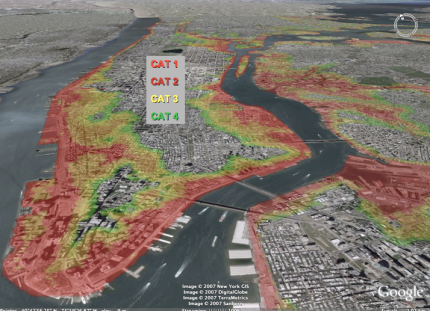
The hurricane was a Category 3 on the Saffir-Simpson scale when it made landfall (after peaking at Cat 5 out to sea) and devastated much of eastern Long Island and the south New England coast. Wind damage in New York City wasn't extreme but flooding was (viz the photo above). Of course, this wasn't the only major hurricane to hit New York City; the 1893 Hog Island Hurricane, for example, is so named because it washed away most of Hog Island in between Long Island and Long Beach.

More generally, this is a tidy, local, little example of one of the fundamental problems with disasters, namely that we often generalize about dangerous events over a period of time (e.g., the lifespan of a high school student) much shorter than the average amount of time between those events. New York City seems from casual remembrance to be at no serious risk from hurricanes, but looking at past history indicates that we will surely get hit by a big one sometime sooner or later. And it's certainly better to accept that risk and prepare for it than otherwise.

Some more resources on the LIE Hurricane can be found here, and PBS actually has a documentary about it here.