Showing posts with label behavioral economics. Show all posts

4.02.2015

Disasters and religiosity

Jeanet Sinding Bentzen has a new version of her working paper on disasters (mostly earthquakes) and religiosity:
Acts of God: Religiosity and Natural Disasters Across Subnational World Districts
Religiosity affects everything from fertility and labor force participation to health. But why are some societies more religious than others? To answer this question, I test the religious coping theory, which states that many individuals draw on their religious beliefs to understand and deal with adverse life events. Combining subnational district level data on values across the globe from the World Values Survey with spatial data on natural disasters, I find that individuals are more religious when their district was hit recently by an earthquake. And further, that individuals are more religious when living in areas with higher long term earthquake risk. Using data on children of immigrants in Europe, I document that this is mainly due to a long-term effect: high religiosity levels evolving in high earthquake risk areas, is passed on through generations to individuals no longer living in high earthquake risk areas. The impact is global: earthquakes increase religiosity both within Christianity, Islam, and Hinduism, and within all continents. Last, I document that the results are consistent with the literature on religious coping and inconsistent with alternative theories of insurance or selection.
Selected quote:
"The estimates indicate that increasing earthquake risk by 30 percentiles from the median increases religiosity by 9 percentiles. The tendency is global: Christians, Muslims, and Hindus all exhibit higher religiosity in response to elevated earthquake risk, and so do inhabitants of every continent."
 via Amir.

4.23.2013

Self-control and long run outcomes


A gradient of childhood self-control predicts health, wealth, and public safety
Terrie E. Moffitt et al.
Abstract: Policy-makers are considering large-scale programs aimed at selfcontrol to improve citizens’ health and wealth and reduce crime. Experimental and economic studies suggest such programs could reap benefits. Yet, is self-control important for the health, wealth, and public safety of the population? Following a cohort of 1,000 children from birth to the age of 32 y, we show that childhood selfcontrol predicts physical health, substance dependence, personal finances, and criminal offending outcomes, following a gradient of self-control. Effects of children’s self-control could be disentangled from their intelligence and social class as well as from mistakes they made as adolescents. In another cohort of 500 sibling-pairs, the sibling with lower self-control had poorer outcomes, despite shared family background. Interventions addressing self-control might reduce a panoply of societal costs, save taxpayers money, and promote prosperity.
click to enlarge
 Related results from China's One Child Policy here.

3.22.2013

Some of my best friends are only-children


Little Emperors: Behavioral Impacts of China’s One-Child Policy
L. Cameron, N. Erkal, L. Gangadharan, X. Meng
We document that China’s One-Child Policy (OCP), one of the most radical approaches to limiting population growth, has produced significantly less trusting, less trustworthy, more risk-averse, less competitive, more pessimistic, and less conscientious individuals. Our data were collected from economics experiments conducted with 421 individuals born just before and just after the OCP’s introduction in 1979. Surveys to elicit personality traits were also used. We used the exogenous imposition of the OCP to identify the causal impact of being an only child, net of family background effects. The OCP thus has significant ramifications for Chinese society.
Click to enlarge

Maybe my favorite aspect of the study is not the content but the design: analyzing cohort effects using [a battery of] lab experiments.

7.05.2012

Neurological basis for altruism

I don't usually read Nature Neuroscience, but this is an interesting neuro-economics piece.

Dorsolateral and ventromedial prefrontal cortex orchestrate normative choice

Thomas Baumgartner, Daria Knoch, Philine Hotz, Christoph Eisenegger & Ernst Fehr

Abstract: Humans are noted for their capacity to over-ride self-interest in favor of normatively valued goals. We examined the neural circuitry that is causally involved in normative, fairness-related decisions by generating a temporarily diminished capacity for costly normative behavior, a 'deviant' case, through non-invasive brain stimulation (repetitive transcranial magnetic stimulation) and compared normal subjects' functional magnetic resonance imaging signals with those of the deviant subjects. When fairness and economic self-interest were in conflict, normal subjects (who make costly normative decisions at a much higher frequency) displayed significantly higher activity in, and connectivity between, the right dorsolateral prefrontal cortex (DLPFC) and the posterior ventromedial prefrontal cortex (pVMPFC). In contrast, when there was no conflict between fairness and economic self-interest, both types of subjects displayed identical neural patterns and behaved identically. These findings suggest that a parsimonious prefrontal network, the activation of right DLPFC and pVMPFC, and the connectivity between them, facilitates subjects' willingness to incur the cost of normative decisions.

(a) Overlay of the pVMPFC cluster that showed a larger change in connectivity after unfair offers (compared with fair offers) with the right DLPFC in the left compared with the right TMS group (yellow, at P < 0.005, cluster extent = 18 voxels42) and the pVMPFC cluster that showed differential activation in the contrast unfair > fair offers in the left compared with the right TMS group (red). Overlapping voxels are displayed in orange. (b) Bar plots based on the functional ROI (red) from a indicate that the differential context-dependent change in connectivity between the left and right TMS group was qualified by a differential change in connectivity during unfair offers (unfair connectivity), but not during fair offers (fair connectivity). The left TMS group therefore only showed an increased connectivity between the right DLPFC and pVMPFC at P < 0.01 during unfair offers, whereas the connectivity between these two brain regions did not change (relative to baseline connectivity) after fair offers. Moreover, after right TMS, the connectivity between right DLPFC and pVMPFC never deviated from the baseline (indicated by the two black bars); that is, these brain regions no longer communicated more after unfair offers. Bar plots depict mean ± s.e.m. [From Nature Neuroscience]


11.24.2011

Math studying = f(weather)

At MIT we used to joke that the earth science department turned on the "weather machine" on the days when prospective students were visiting and trying to decide whether to enroll (since the weather always seemed to be perfect).  But maybe the admissions department got a sign mixed up when then told EAPS what kind of weather they wanted.

More seriously, this may be important for explaining labor supply responses to the weather.

Weather to go to college
Uri Simonsohn

Abstract: Does current utility bias predictions of future utility for high stakes decisions? Here I provide field evidence consistent with such Projection Bias in one of life’s most thought-about decisions: college enrolment. After arguing and documenting with survey evidence that cloudiness increases the appeal of academic activities, I analyse the enrolment decisions of 1,284 prospective students who visited a university known for its academic strengths and recreational weaknesses. Consistent with the notion that current weather conditions influence decisions about future academic activities, I find that an increase in cloudcover of one standard deviation on the day of the visit is associated with an increase in the probability of enrolment of 9 percentage points.


7.27.2011

Hyperinflation and the birth of the real

NPR has a fascinating piece on how the Brazilian real (plural reais) was created in the early nineties to end hyperinflation. In short: it was originally a non-circulating, purely denominational currency meant to stabilize price expectations :
"We called it a Unit of Real Value — URV," Bacha says. "It was virtual; it didn't exist in fact."

People would still have and use the existing currency, the cruzeiro. But everything would be listed in URVs, the fake currency. Their wages would be listed in URVs. Taxes were in URVs. All prices were listed in URVs. And URVs were kept stable — what changed was how many cruzeiros each URV was worth.

Say, for example, that milk costs 1 URV. On a given day, 1 URV might be worth 10 cruzeiros. A month later, milk would still cost 1 URV. But that 1 URV might be worth 20 cruzeiros.

The idea was that people would start thinking in URVs — and stop expecting prices to always go up.

"We didn't understand what it was," says Maria Leopoldina Bierrenbach, a housewife from Sao Paulo. "I used to say it was a fantasy, because it was not real."
Yes, there are other ways of ending hyperinflation, but you have to say this one has its special charm.

5.31.2011

Incentives work for online labor, too


A nice experimental paper on online labour market incentives just got presented at the ACM Conference on Computer Supported Cooperative Work (CSCW). It's by John Horton, Daniel Chen and Aaron Shaw and covers different incentives' impact on success rates for a set of simple Mechanical Turk questions. Shaw summarizes it nicely at his blog :
The results surprised us. They suggest that workers perform most accurately when the task design credibly links payoffs to a worker’s ability to think about the answers that their peers are likely to provide.
That priming technique is referred to catchily as "Bayesian Truth Serum" and its setup (from the paper online) behooves a little extra attention:
Bayesian Truth Serum or BTS (financial) “For the following five questions, we will also ask you to predict the responses of other workers who complete this task. There is no incentive to misreport what you truly believe to be your answers as well as others’ answers. You will have a higher probability of winning a lottery (bonus payment) if you submit answers that are more surprisingly common than collectively predicted.”
BTS was designed by Drazen Prelec at MIT, and you can get the original paper (I believe) here.

In short, the setup exemplifies what I think is particularly great about data analysis these days: Shaw, Horton, and Chen manage to put together a very tight, deeply informative and even slightly controversial (psych and sociological priming are not so effective) paper that really required nothing more than an internet connection, some computational power for the stats, and a clever eye. Go check it out.


4.20.2011

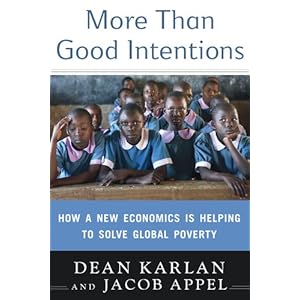
Karlan and Appel's "More Than Good Intentions"


Dean Karlan and Jacob Appel's new book More Than Good Intentions (previously mentioned here) is coming out tomorrow and Sol and I got a hold of review copies. To that end, a review:

Overall it's a great read. Karlan does behavioral development economics with a big emphasis on Poverty Action Lab-style randomized control trials, and the book is essentially a thematicized overview of the current state of that field. What's particularly worth noting is that behavioral development econ is very new: most of the papers and studies covered are from the last ten years (Googling around a bit turns up what I think is the earliest lit review from 2006), and as far as I can tell this is the first book on the subject at all.

That newness shows up in the general slant of the book. A lot of general-audience econ and science books tend towards pithy summaries of major results from the author's area of research (e.g., "libertarian paternalism works" or "clever identification can reveal crazy facts"). But the pithy summary of this book would probably be something like "psychology really affects economic outcomes in developing contexts, sometimes hugely, and here's some promising early evidence." There's less a grand thesis that's being hammered away at so much as a constellation of interesting data points all hinting at a new and interesting way to think about the fundamental problems of development.

Some of those seem very promising. The multiple sections on microfinance provide a lot of worthwhile food for thought, and Karlan & Appel's emphasis on the importance of providing microsavings as opposed to simply microcredit is particularly welcome. Other parts of the book on areas like agriculture, health, etc. seem to me almost as if they should be "behavioral" chapters in books on those subjects, which really is another way of saying that the field is young and there's a lot of research waiting to be done.

In short, the book was fun, engaging, and a quick read, and in combination with some background texts could probably could sub out for a nice undergrad class on behavioral development economics. I'd especially recommend it to high school and college students who are interested in development and trying to get oriented in the field / find out who the major players are / figure out which open problems are juiciest.

4.11.2011

ARV recovery video

Sol and I are both reading Dean Karlan and Jacob Appel's new book More Than Good Intentions these days. It's on behavioral solutions to development problems, it covers a good deal of very current applied development economics, and we'll be throwing a review up on the blog shortly (thus far I've enjoyed it enormously).

In the meantime, though, I thought I'd link to what I think is a stellar example of just such a behavioral solution to a development problem, namely, this ad for anti-retroviral AIDS drugs:


How is that behavioral? Well, I think it's one thing to hear about the remarkable reversal of decline that ARVs bring about in otherwise-terminal AIDS patients. It's another thing to see it and identify with it. That may seem obvious, but Karlan and Appel's book is one of the first to discuss marketing in the context of development solutions. I think that's a lovely way, to piggyback on Sol's earlier post, to benchmark just how far development economics still has to go.