Showing posts with label disasters. Show all posts

4.02.2015

Disasters and religiosity

Jeanet Sinding Bentzen has a new version of her working paper on disasters (mostly earthquakes) and religiosity:
Acts of God: Religiosity and Natural Disasters Across Subnational World Districts
Religiosity affects everything from fertility and labor force participation to health. But why are some societies more religious than others? To answer this question, I test the religious coping theory, which states that many individuals draw on their religious beliefs to understand and deal with adverse life events. Combining subnational district level data on values across the globe from the World Values Survey with spatial data on natural disasters, I find that individuals are more religious when their district was hit recently by an earthquake. And further, that individuals are more religious when living in areas with higher long term earthquake risk. Using data on children of immigrants in Europe, I document that this is mainly due to a long-term effect: high religiosity levels evolving in high earthquake risk areas, is passed on through generations to individuals no longer living in high earthquake risk areas. The impact is global: earthquakes increase religiosity both within Christianity, Islam, and Hinduism, and within all continents. Last, I document that the results are consistent with the literature on religious coping and inconsistent with alternative theories of insurance or selection.
Selected quote:
"The estimates indicate that increasing earthquake risk by 30 percentiles from the median increases religiosity by 9 percentiles. The tendency is global: Christians, Muslims, and Hindus all exhibit higher religiosity in response to elevated earthquake risk, and so do inhabitants of every continent."
 via Amir.

11.13.2013

Destruction, Disinvestment, and Death: Economic and Human Losses Following Environmental Disaster

Typhoon Haiyan as seen from space, Copyright 2013 JMA/EUMETSAT
Last spring Sol and I finished up the working paper version of our paper "Destruction, Disinvestment, and Death: Economic and Human Losses Following Environmental Disaster." Since the paper is long and fairly technical, we decided it would be worthwhile to do a shorter, more general-audience-appropriate piece for the blog, something that seems especially relevant given Typhoon Haiyan's devastating landfall this past weekend. If you'd like to take a look at the paper itself, you can find a copy of it here on SSRN; a copy of the supplemental appendix can be found here.

The motivation for "Destruction, Disinvestment, and Death" stems from the fact that we actually know surprisingly little about how people fare in the wake of natural disasters.

7.23.2013

Seismic externalities

Injection-Induced Earthquakes
William L. Ellsworth
Abstract: Earthquakes in unusual locations have become an important topic of discussion in both North America and Europe, owing to the concern that industrial activity could cause damaging earthquakes. It has long been understood that earthquakes can be induced by impoundment of reservoirs, surface and underground mining, withdrawal of fluids and gas from the subsurface, and injection of fluids into underground formations. Injection-induced earthquakes have, in particular, become a focus of discussion as the application of hydraulic fracturing to tight shale formations is enabling the production of oil and gas from previously unproductive formations. Earthquakes can be induced as part of the process to stimulate the production from tight shale formations, or by disposal of wastewater associated with stimulation and production. Here, I review recent seismic activity that may be associated with industrial activity, with a focus on the disposal of wastewater by injection in deep wells; assess the scientific understanding of induced earthquakes; and discuss the key scientific challenges to be met for assessing this hazard.
Perhaps an enterprising graduate student can figure out an optimal management strategy for this risk.

11.02.2012

Should people living in high-risk locations get relief when they are hit by natural disasters?


National survey evidence on disasters and relief: Risk beliefs, self-interest, and compassion
W. Kip Viscusi, Richard J. Zeckhauser
Abstract: A nationally representative sample of respondents estimated their fatality risks from four types of natural disasters, and indicated whether they favored governmental disaster relief. For all hazards, including auto accident risks, most respondents assessed their risks as being below average, with one-third assessing them as average. Individuals from high- risk states, or with experience with disasters, estimate risks higher, though by less than reasonable calculations require. Four-fifths of our respondents favor government relief for disaster victims, but only one-third do for victims in high-risk areas. Individuals who perceive themselves at higher risk are more supportive of government assistance.
Un-gated version here. The conclusion is succinct:
This paper explored two broad questions: 1. What factors drive individuals’ beliefs about their risks from various disasters, and how accurate are those beliefs? 2. What policies do individuals favor for disaster relief, and how do those policies relate to their assessed risks?
The answer to the first question is that risk beliefs have many rational components, but fall short of what one would expect with fully rational Bayesian assessments of risk. Personal experience and location-related risk influence risk assessments in the right direction, but insufficiently. These factors should have a very powerful influence, as our Lorenz Curve for fatality risks by state shows that natural disaster risks are highly concentrated, unlike auto fatality risks. 
For each of our four natural disasters, more than half of our respondents thought that their fatality risk from natural disasters was below average, and another roughly thirty-five percent thought their risk was average. Even people who had experienced disasters did not differ markedly from those who had not. 
A common explanation for apparent underestimation of risks, such as those from auto accidents, is that individuals suffer from an illusion of control. That explanation does not apply to natural disasters. A plausible hypothesis, worthy of further study, is that individuals actually understand the skewness in the distribution of risk. Though only half of the population can be below median risk, the vast majority are below average in risk. That is surely true for auto accidents as well, the favorite domain for “control” hypotheses. 
More than four-fifths of our respondents favored government assistance for victims of natural disasters, but this fraction fell to only one-third when the natural disasters happened to people living in high-risk areas. This decline suggests that respondents intuitively un- derstand the concept of moral hazard. We label this phenomenon “efficient compassion.” That is, there is a strong element of compassion in their responses, but it is tempered when disaster victims have knowingly exposed themselves to high risk. Individuals who perceive themselves to be at greater personal risk are more supportive of government assistance, as are groups that tend to be liberal politically. Black respondents, who may have been particu- larly struck by the governmental failure to rescue the black population of New Orleans from Hurricane Katrina, are much more supportive of continued aid to that city. In short, policy preferences for disaster relief reflect both compassion for the unfortunate, and a dollop of self-interest.
More interesting excerpts:
Political orientation is a main driver of the support for relief, not just for the efficient compassion questions, but for all the relief options. In every instance, Republicans have a consistently lower probability of supporting the relief policies than do Democrats and independents. After controlling for political affiliation, blacks have higher probabilities for support; females also have higher probabilities, though not where moral hazard is a prime factor. Presumably, these groups are more liberal than their mere political affiliation indicates... 
The equations also included a measure of individual risk-taking behavior—the general health risk exposure of the respondent as reflected in whether they currently smoke cigarettes. Smokers face a considerable smoking-related mortality risk; their probability of premature death due to smoking is 1/6 to 1/3. The smoker variable consequently captures willingness to expose oneself to extremely large health risks. Beyond this, the smoker variable may also reflect a tolerance for others who take risks and are guilty of moral hazard, since smokers are frequent targets of criticism for their own risk-taking behavior. For the two relief questions involving individual choices to engage in risky behavior, smokers are more forgiving of decisions involving moral hazard and are more willing to support relief. Both effects are significant at the 10 percent level. 

10.31.2012

Hurricanes and the social safety net in US counties


The social safety net catches people after a hurricane, but this cost to society is generally not accounted for in standard estimates of a hurricane's economic impact.

The Role of Transfer Payments in Mitigating Shocks: Evidence from the Impact of Hurricanes
Tatyana Deryugina
Abstract: Little is known empirically about how aggregate economic shocks are mitigated by social safety nets. I examine the effect of hurricanes on US counties. While I find no significant changes in population, earnings, and the employment rate 0-10 years after landfall, there is a substantial increase in non-disaster government transfers. An affected county receives additional non-disaster government transfers totaling $654 per capita, which suggests that the lack of changes in basic economic indicators may be in part due to existing social safety nets. The fiscal costs of natural disasters are also much larger than the cost of disaster aid alone.

click to enlarge

click to enlarge 

Deryugina writes:
The number of construction firm locations (establishments) declines by 1.6% each year with no change in the mean. Construction employment is on average 7.6% lower in the ten years following the hurricane, and declines by 2.0% per year. The overall decline in employment suggests a drop in construction demand. This is confirmed by estimates of per capita single family housing starts, which are 8% lower on average. Wages increase by an average of 6.8%, but then fall by 0.9% each year, suggesting there may be a temporary change in the composition of construction labor demand (e.g., more demand for specialized workers) or lower labor supply… 
One possible interpretation of the decline in the local construction sector is spatial: the con- struction industry may have simply moved to nearby counties without any net effect on the sector. The implications of spatial changes, while non-trivial for the local economy, are different than if there’s a widespread capital shock. However, the fall in per capita housing starts provides evidence of a significant decrease in construction demand. Thus, the downturn in the local construction sector is not solely driven by spatial shifts in construction activity. 
There is no change in the employ- ment rate or per capita net earnings. Using 95% confidence bounds, I can rule out a decrease in mean earnings greater than 1.8% and a decrease in the mean employment rate greater than 0.5% The mean shift test for transfers indicates a 2.1% average increase in per capita government to individual transfers, equivalent to about $69 per person per year. Per capita business to individ- ual transfers in the eleven years following the hurricane are estimated to be 4.8% higher than the pre-hurricane transfers, or about $3.9 per year. There are no significant changes in the trends of any of these variables. Assuming a 3% discount rate, the present discounted value (PDV) of all government transfers is about $654 per capita, and the PDV of transfers from businesses is $37 per capita. Thus, post-hurricane transfers from general social programs are larger than transfers from disaster-specific programs and much larger than insurance payments. Because the non-disaster transfers are still significantly larger 10 years after the hurricane, the estimate of $654 per capita should be viewed as a lower bound.

The subcomponents of total government transfers to individuals are: retirement and disability insurance benefits (which includes workers’ compen-sation), medical benefits (which includes Medicare and Medicaid), income maintenance (which includes Supplemental Security Income, family assistance, and foot stamps), unemployment ben- efits, veterans’ benefits, and federal education assistance. A separate analysis of each of these components (following the same procedure as for total transfers) reveals that increases in medical and unemployment benefits explain the overwhelming majority of the net increase in total non- disaster transfers. Specifically, public medical benefits increase significantly by $435 per capita in PDV, of which $106 is Medicare spending. The estimated change in Medicare spending is not significant. 18 Because there is no significant increase in Medicare spending, the increase in pub- lic medical spending is likely due to changes in the number of people eligible for public medical benefits rather than increased medical spending on existing recipients. 
Unemployment benefits increase by about $280 per capita in PDV. There is no significant change in aggregate income maintenance (although some subcomponents, such as family assis- tance, do increase slightly) and no significant change in retirement and disability insurance bene- fits, per capita federal education assistance, or per capita veteran benefits. Thus, the majority of the increase in transfers is accounted for by unemployment insurance and public medical benefits.

Access to hardened infrastructure and hurricane mortality


I just happen to be working on a review of hurricane's socio-economic impacts right now, and since there seems to be widespread interest in these things at the moment, I'm just going to post some of the more interesting/important papers as I go. The figure from this 1993 paper is compelling (although I think a brace would be clearer than the arrow).

Risk factors for mortality in the Bangladesh cyclone of 1991
C. Bern, J.Sniezek, G.M. Mathbor, M.S. Sidiqi, C. Ronsmans, A.M.R. Chowdhury, A.E. Choudhury, K. Islam, M. Bennish, E. Noji, & R.l.Glass
Abstract: Cyclones continue to pose a dangerous threat to the coastal populations of Bangladesh, despite improvements in disaster control procedures. After 138 000 persons died in the April 1991 cyclone, we carried out a rapid epidemiological assessment to determine factors associated with cyclone-related mortality and to identify prevention strategies. A nonrandom survey of 45 housing clusters comprising 1123 persons showed that mortality was greatest among under-10-year-olds (26%) and women older than 40 years (31%). Nearly 22% of persons who did not reach a concrete or brick structure died, whereas alpersons who sought refuge in such structures survived. Future cyclone-associated mortality in Bangladesh could be prevented by more effective warnings leading to an earlier response, better access to designated cyclone shelters, and improved preparedness in high-risk communities. In particu- lar, deaths among women and under-10-year-olds could be reduced by ensuring that they are given special attention by families, neighbours, local authorities, and especially those in charge of early warnings and emergency evacuation.

From the results:

Type of housing and shelter-seeking activity were directly related to the risk of dying in the cyclone (Fig. 2). No deaths occurred among the 27 individuals (2%) who lived in pukka houses or remained in pukka public buildings for the duration of the cyclone. However, 1094 individuals (98%) were not in a safe shelter prior to the cyclone warning. In response to the warning, which most respondents reported hearing 3-6 hours prior to the storm surge, only 40 individuals (4%) sought and reached safe shelter.When the flood waters first reached the area 10-60 minutes before the storm surge, 151 persons (13%) were insafeshelter.In all, 385 persons (33%) had reached safe shelter by the moment of impact of the storm surge; none of these persons died In con- trast, of 736 persons at risk, 162 (22%; P < 0.0001) drowned in the flood waters.
Of 736 persons at risk at the time of the cyclone impact, 285 were swept away in the storm surge; of these, 112 (39%) died. Another 179 per- sons were able to float on some object, generally the thatch roof of their house; of these, 27 (15%) died. Mortality was 22% among those who sought high ground to escape the storm surge, and 11% among those who took refuge in trees.


10.30.2012

Will Hurricane Sandy affect the US presidential election?


The literature says: yes. Now let's see if Ohio get's a disaster declaration...

The Political Economy of FEMA disaster Payments 
(non-paywalled working paper)
THOMAS A. GARRETT and RUSSELL S. SOBEL
ABSTRACT: We find that presidential and congressional influences affect the rate of disaster declaration and the allocation of FEMA disaster expenditures across states. States politically important to the president have a higher rate of disaster declaration by the president, and disaster expenditures are higher in states having congressional representation on FEMA oversight committees. Election year impacts are also found. Our models predict that nearly half of all disaster relief is motivated politically rather than by need. The findings reject a purely altruistic model of FEMA assistance and question the relative effectiveness of government versus private disaster relief.

Myopic Voters and Natural Disaster Policy

ANDREW HEALY & NEIL MALHOTRA
ABSTRACT: Do voters effectively hold elected officials accountable for policy decisions? Using data on natural disasters, government spending, and election returns, we show that voters reward the incumbent presidential party for delivering disaster relief spending, but not for investing in disaster pre- paredness spending. These inconsistencies distort the incentives of public officials, leading the government to underinvest in disaster preparedness, thereby causing substantial public welfare losses. We estimate that $1 spent on preparedness is worth about $15 in terms of the future damage it mitigates. By estimating both the determinants of policy decisions and the consequences of those policies, we provide more complete evidence about citizen competence and government accountability.

BLIND RETROSPECTION ELECTORAL RESPONSESTO DROUGHT, FLU, AND SHARK ATTACKS
Christopher H. Achen and Larry M. Bartels
ABSTRACT: Students of democratic politics have long believed that voters punish incumbents for hard times. Governments bear the responsibility for the economy in the modern era, so that replacing incompetent managers with capable alternatives appears to be a well-informed, rational act. However, this vision of a sophisticated retrospective electorate does not bear close examination. We find that voters regularly punish governments for acts of God, including droughts, floods, and shark attacks. As long as responsibility for the event itself (or more commonly, for its amelioration) can somehow be attributed to the government in a story persuasive within the folk culture, the electorate will take out its frustrations on the incumbents and vote for out-parties. Thus, voters in pain are not necessarily irrational, but they are ignorant about both science and politics, and that makes them gullible when ambitious demagogues seek to profit from their misery. Neither conventional understandings of democratic responsiveness nor rational choice interpretations of retrospective voting survive under this interpretation of voting behavior.  


Probabilistic forecast of direct damage from Hurricane Sandy

Posted at G-FEED.

9.28.2012

Crowd sourcing analysis of tropical cyclones via satellite imagery

Ken Knapp points us to cyclonecenter.org, a new program to crowd-source the analysis of global tropical cyclone records:

Climate scientists need your help classifying over 30 years of tropical cyclone satellite imagery. 
The global intensity record contains uncertainties caused by differences in analysis procedures around the world and through time. Scientists are enlisting the public because patterns in storm imagery are best recognized by the human eye. 
CycloneCenter.org is a web-based interface that enables the public to help analyze the intensities of past tropical cyclones around the globe. The global intensity record contains uncertainties caused by differences in analysis procedures around the world and through time. Patterns in storm imagery are best recognized by the human eye, so scientists are enlisting the public. Interested volunteers will be shown one of nearly 300,000 satellite images. They will answer questions about that image as part of a simplified technique for estimating the maximum surface wind speed of tropical cyclones. This public collaboration will perform more than a million classifications in just a few months—something it would take a team of scientists more than a decade to accomplish. The end product will be a new global tropical cyclone dataset that provides 3-hourly tropical cyclone intensity estimates, confidence intervals, and a wealth of other metadata that could not be realistically obtained in any other fashion.
I use these global records all the time, so I will be personally thankful to anyone who helps improve them.

7.17.2012

Using cell phones to track post-disaster population movements in Haiti

Predictability of population displacement after the 2010 Haiti earthquake

Xin Lu, Linus Bengtsson, and Petter Holme

Abstract: Most severe disasters cause large population movements. These movements make it difficult for relief organizations to efficiently reach people in need. Understanding and predicting the locations of affected people during disasters is key to effective humanitarian relief operations and to long-term societal reconstruction. We collaborated with the largest mobile phone operator in Haiti (Digicel) and analyzed the movements of 1.9 million mobile phone users during the period from 42 d before, to 341 d after the devastating Haiti earthquake of January 12, 2010. Nineteen days after the earthquake, population movements had caused the population of the capital Port-au-Prince to decrease by an estimated 23%. Both the travel distances and size of people’s movement trajectories grew after the earthquake. These findings, in combination with the disorder that was present after the disaster, suggest that people’s movements would have become less predictable. Instead, the predictability of people’s trajectories remained high and even increased slightly during the three-month period after the earthquake. Moreover, the destinations of people who left the capital during the first three weeks after the earthquake was highly correlated with their mobility patterns during normal times, and specifically with the locations in which people had significant social bonds. For the people who left Port-au-Prince, the duration of their stay outside the city, as well as the time for their return, all followed a skewed, fat-tailed distribution. The findings suggest that population movements during disasters may be significantly more predictable than previously thought.

h/t Kyle

5.09.2012

AGU Science Policy Recap


Last week I had the pleasure of attending the first AGU Science Policy Conference in DC. One of the things I like the most about AGU events is the wide variety of academic fields from which attendees are drawn, and even given the comparatively narrow focus of this conference (there were only about twenty sessions, compared to the AGU annual meetings's thousands) the number of interesting ideas and novel concepts afloat was overwhelming. Below the fold are selected highlights, notes, and interesting errata from the two days I was there...

4.26.2012

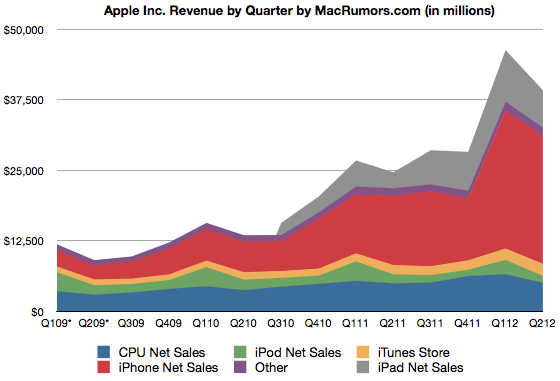
Which number from 2011 is bigger: Apple revenue or global insured losses to all weather disasters?

Answer: Apple revenue.

In my line of work, it's good to cultivate a sense of scale for ridiculously large numbers.  So when I saw this on MR:
For the quarter, Apple posted revenue of $39.2 billion and net quarterly profit of $11.6 billion... 

From Macrumors

I thought, "Wow, that's the same order of magnitude as this:"

From Swiss Re Sigma

Except, when integrated across four quarters, Apple is larger (~$100B) than global insured losses to weather (~$60B).

But before you run off thinking that weather isn't costly, remember that only a fraction of all weather losses are insured (probably ~5-15% globally, is my guess, but it's a very hard number to pin down). So global losses to weather are probably substantially larger than Apple's revenue, at least until iPhone 5 is released...

12.12.2011

Fukushima's long-term implications

Two articles came out in PNAS Environmental Sciences this week estimating the fallout from the Fukushima nuclear disaster (Yasunari et al. and Kinoshita et al.). Of particular concern is the following from Yasunari et al.:
As a general characteristic, most of the eastern parts of Japan were effected by a total 137 Cs deposition of more than 1,000 MBq km−2 . Our estimates show that the area around NPP in Fukushima, secondarily effected areas (Miyagi and Ibaraki prefectures), and other effected areas (Iwate, Yamagata, Tochigi, and Chiba prefectures) had 137 Cs depositions of more than 100,000, 25,000, and 10,000 MBq km−2 , respectively. Airborne and ground-based survey measurements jointly carried out by MEXT and the US Department of Energy (DOE) (21) show high 137 Cs deposition amounts were observed northwestward and up to a distance of 80 km from Fukushima NPP. It was estimated from the first measurement that by April 29, more than 600,000 MBq km−2 had been deposited in the area, which is greater than our estimate of less than 500,000 MBq km−2 (Fig. 2A), yet well within the range of uncertainty of our method (Fig. S4).
1,000 MBq (megabecquerels) per square kilometer is 1 kilobecquerel per square meter, so the three broad exposure estimates correspond to 100, 25, and 10 kBq m-2, with maximum treatments around 500-600 kBq m-2. To answer how worried we should be about this, we turn to Almond, Edlund, and Palme, 2009:
We use prenatal exposure to Chernobyl fallout in Sweden as a natural experiment inducing variation in cognitive ability. Students born in regions of Sweden with higher fallout performed worse in secondary school, in mathematics in particular. Damage is accentuated within families (i.e., siblings comparison) and among children born to parents with low education. In contrast, we detect no corresponding damage to health outcomes. To the extent that parents responded to the cognitive endowment, we infer that parental investments reinforced the initial Chernobyl damage. From a public health perspective, our findings suggest that cognitive ability is compromised at radiation doses currently considered harmless.
The heaviest fallout in Sweden (also due to Cesium 137 contamination) was around 65 kBq m-2 (see figure 2 of the paper). Moreover Japan's population density is roughly an order of magnitude larger than Sweden's. Given this, it looks like the long term human costs of this disaster may be absolutely staggering.

9.13.2011

Natural disaster management game

I know some people really love designing simulation games to educate people. I have no strong feelings on this and also have no idea if this kind of training works (RCT anyone?), but here's one I found today: www.stopdisastersgame.org

It's sponsored by the UN International Strategy for Disaster Reduction.

If you hate fun as much as I do, you can read this instead.


5.25.2011

TRMM Satellite picks up Joplin tornado


Our colleague and occasional guest poster Kyle Meng points out that NASA's TRMM satellite (previously here) passed over the supercell that generated this past weekend's megatornado in Joplin, MO, generating a map of the resultant precipitation. You can find out about it here.