Showing posts with label public finance. Show all posts

12.11.2012

Is it true that "Everyone's a winner?" Dams in China and the challenge of balancing equity and efficiency during rapid industrialization

Jesse and I both come from the Sustainable Development PhD Program at Columbia which has once again turned out a remarkable crop of job market candidates (see outcomes from 2012 and 2011). We both agreed that their job market papers were so innovative, diverse, rigorous and important that we wanted to feature them at FE.  Their results are striking and deserve dissemination (we would probably post them anyway even if the authors weren't on the market), but they also clearly illustrate what the what the Columbia program is all about. (Apply to it here, hire one of these candidates here.) Here is the third and final post.

Large infrastructure investments are important for large-scale industrialization and economic development. Investments in power plants, roads, bridges and telecommunications, among others, provide important returns to society and are compliments to many types of private investment. But during rapid industrialization, as leaders focus on growth, there is often concern that questions of equity are cast aside. In the case of large-scale infrastructure investments, there are frequently populations ("losers") that suffer private costs when certain types of infrastructure are built -- for example, people whose homes are in the path of a new highway or who are affected by pollution from a power plant.

In public policy analysis and economics, we try to think objectively of the overall benefits of large investments to an entire society, keeping in mind that there will usually be some "losers" from the new policy in addition to a (hopefully larger) group of "winners."  In the cost-benefit analysis of large projects, we usually say if that a project is worth doing if the gains to the winners outweigh the loses to the losers -- making the implicit assumption that somehow the winners can compensate the losers for their loses and continue to benefit themselves. In cases where the winners compensate the losers enough that their losses are fully offset (i.e. they are no longer net losers), we say that the investment is "Pareto improving" because nobody is made worse off by the project.

A Pareto improving project is probably a good thing to do, since nobody is hurt and probably many people benefit. However, in the case of large infrastructure investments, it is almost guaranteed that some groups will be worse off because of the project's effects, so making sure that everyone benefits from these projects will require that the winners actually compensate the losers. Occasionally this occurs privately, but that tends to be uncommon, so with large-scale projects we often think that a central government authority has a role to play in transferring some of benefits from the project away from the winners and towards the losers.

But do these transfers actually occur? In a smoothly functioning government, one would hope so.  But the governments of rapidly developing countries don't always have the most experienced regulators and often pathologies, like corruption, lead to doubt as to whether large financial transfers will be successful.  Empirically, we have little to no evidence as to whether governments in rapidly industrializing countries (1) accurately monitor the welfare lost by losers in the wake of large projects and (2) have the capacity necessary to compensate these losers for their loses. Thus, establishing whether governments can effectively compensate losers is important for understanding whether large-scale infrastructure investments can be made beneficial (or at least "not harmful") for all members of society.

Xiaojia Bao investigates this question for the famous and controversial example of dams in China. Over the last few decades, a large number of hydroelectric dams have been build throughout China. These dams are an important source of power for China's rapidly growing economy, but they also can lead to inundation upstream, a reduction in water supply downstream, and a slowed flow of water that leads to an accumulation of pollutants both upstream and downstream.

Bao asks whether the individuals who are adversely affected by new dams are compensated for their losses. To do this, she obtains data on dams and municipal-level data on revenue and transfers from the central government.   She uses geospatial analysis to figure out which municipalities are along rivers that are dammed and also which are upstream, downstream or at the dam site.  She then compares how the construction of a new dam alters the distribution of revenues and federal transfers to municipalities along the dammed river, in comparison to adjacent municipalities that are not on the river.

Bao finds that the Chinese government has been remarkably good at compensating those communities who suffer when dams are built.  Municipalities upstream of a dam lose the most revenue both while the dam is being built and after it become operational. But at the same time, the central government increases transfers to those municipalities sufficiently so that these municipalities suffer no net loss in revenue. In contrast, populations just downstream look like they benefit slightly from the dam's operation, increasing their revenue -- and it appears that the central government is also good at reducing transfers to those municipalities so that these gains are effectively "taxed away." The only group that is a clear net winner are the municipalities that host the actual dam itself, as their revenue rises and the central government provides them with additional transfers during a dam's construction.

These findings are important because we often worry that large-scale investment projects may exacerbate existing patterns of inequality, as populations that are already marginalized are saddled with new burdens for the sake of the "greater good." However, in cases where governments can effectively distribute the benefits from large projects so that no group is made worse off, then we should not let this fear prevent us from making the socially-beneficial investments in infrastructure that are essential to long run economic development.

The paper:
Dams and Intergovernmental Transfer: Are Dam Projects Pareto Improving in China?
Xiaojia Bao  
Abstract: Large-scale dams are controversial public infrastructure projects due to the unevenly distributed benefits and losses to local regions. The central government can make redistributive fiscal transfers to attenuate the impacts and reduce the inequality among local governments, but whether large-scale dam projects are Pareto improving is still a question. Using the geographic variation of dam impacts based on distances to the river and distances to dams, this paper adopts a difference-in-difference approach to estimate dam impacts at county level in China from 1996 to 2010. I find that a large-scale dam reduces local revenue in upstream counties significantly by 16%, while increasing local revenue by similar magnitude in dam-site counties. The negative revenue impacts in upstream counties are mitigated by intergovernmental transfers from the central government, with an increase rate around 13% during the dam construction and operation periods. No significant revenue and transfer impacts are found in downstream counties, except counties far downstream. These results suggest that dam-site counties benefit from dam projects the most, and intergovernmental transfers help to balance the negative impacts of dams in upstream counties correspondingly, making large-scale dam projects close to Pareto improving outcomes in China.
In figures...

In China, Bao obtains the location, height, and construction start/stop dates for all dams built before 2010.

click to enlarge

For every dam, Bao follows the corresponding river and calculates which municipalities are "upstream" and which are "downstream." She then computes finds comparison "control" municipalities that are adjacent to these "treatment" municipalities (to account for regional trends). Here is an example for a single dam:

Click to enlarge

Bao estimates the average effect of dam construction (top) and operation(bottom) on municipal revenues as a function of distance upstream (left) or downstream (right).  Locations just upstream lose revenue, perhaps from losing land (inundation) or pollution. Locations at the dam gain revenue, perhaps because of spillovers from dam-related activity (eg. consumer spending). During operation, downstream locations benefit slightly, perhaps from flood control.

click to enlarge

Government transfers during construction/operation upstream/downstream. Upstream locations receive large positive transfers. Municipalities at the dam receive transfers during construction. Downstream locations lose some transfers (taxed away).

click to enlarge

Transfers (y-axis) vs. revenue (x-axis) for locations upstream/downstream and at the dam site, during dam construction. Locations are net "winners" if they are northeast of the grey triangle. Upstream municipalities are more than compensated for their lost revenue through transfers.   Municipalities at the dam site benefit through revenue increases and transfers.

click to enlarge

Same, but for dam operation (after construction is completed). Upstream locations are compensated for losses. Benefits to downstream locations are taxed away. Dam-site locations are net "winners".

Click to enlarge

12.05.2012

Urban bus pollution and infant health: how New York City's smog reduction program generates millions of dollars in benefits

Jesse and I both come from the Sustainable Development PhD Program at Columbia which has once again turned out a remarkable crop of job market candidates (see outcomes from 2012 and 2011). We both agreed that their job market papers were so innovative, diverse, rigorous and important that we wanted to feature them at FE.  Their results are striking and deserve dissemination (we would probably post them anyway even if the authors weren't on the market), but they also clearly illustrate what the what the Columbia program is all about. (Apply to it here, hire one of these candidates here.) Here is the second post.


Around the world, diesel-powered vehicles play a major role in moving people and goods. In particular, buses are heavily utilized in densely populated cities where large numbers of people are exposed to their exhaust. If bus exhaust has an impact on human health, then urban policy-makers would want to know this since it will affect whether or not it's worth it to invest in cleaner bus technologies. Upgrading the quality of public transport systems is usually expensive, but upgrading could have potentially large benefits since so many people live in dense urban centers and are exposed to their pollution. Deciding whether or not to invest in cleaner bus technologies is an important policy decision made by city officials, since buses aren't replaced very often and poor choices can affect city infrastructure for decades -- so its important that policy-makers know what the trade offs are when they make these decisions.

Unfortunately, to date, it has been extremely difficult to know if there are any effects of bus pollution on human health because cities are complex and bustling environments where people are constantly exposed to all sorts of rapidly changing environmental conditions. As one might imagine, looking at a city of ten-million people, each of whom is engaged daily in dozens of interacting activities, and trying to disentangle the web of factors that affect human health to isolate the effect of bus pollution is a daunting task. To tackle this problem, we would need to assemble a lot of data and conduct a careful analysis. This is exactly what Nicole Ngo has done.

Between 1990 and 2010,  New York City made major investments that transformed the city's bus fleet, reducing its emissions dramatically. To study the impact of this policy on human health, Ngo assembled a new massive data set that details exactly which bus drove on which route at what time every single day. Because the city's transition from dirty buses to clean buses occurred gradually over time, and because the dispatcher at the bus depot randomly assigns buses to different routes at different times, the people who live along bus routes were sometimes exposed to exhaust from dirtier buses and sometimes exposed to exhaust from clean buses.  By comparing health outcomes in households that are randomly exposed to the dirtier bus pollution with comparable households randomly exposed to cleaner bus pollution, Ngo can isolate the effect of the bus pollution on health.

In this paper, Ngo focuses on infant health (although I expect she will use this unique data set to study many more outcomes in the future) and measures the effect of a mother's exposure to bus pollution during pregnancy on a child's health at birth.  This is hard problem, since its impossible to know exactly all the different things that a mother does while she's pregnant and because Ngo has to use pollution data collected from air-quality monitors to model how pollution spreads from bus routes to nearby residences.  Despite these challenges, Ngo is able to detect the effect of in utero exposure to bus pollution on an infant's health at birth.  Fetuses that are exposed to higher levels of bus-generated Nitrous-Oxides (NOx) during their second and third trimester have a lower birthweight on average and fetuses exposed to more bus-generated particulate matter (PM) during those trimesters have a lower Apgar 5 score (a doctors subjective evaluation of newborn health).

The size of the effects that Ngo measures are relatively small for any individual child (so if you are pregnant and living near a bus route, you shouldn't panic).  But the aggregate effect of New York City's investment in clean buses is large, since there are many pregnant mothers who live near bus routes and who were exposed to less dangerous emissions because of these policies. Since its easiest to think about city-wide impacts using monetized measures, and because previous studies have demonstrated that higher birth weight causes an infants future income to be higher, Ngo aggregates these small impacts across many babies and estimates that the city's effort to upgrade buses increase total future earnings of these children by $66 million. Considering that the city upgraded roughly 4500 buses, this implies that each bus that was upgraded generated about $1,460 in value just through its influence on infant health and future earnings. Importantly however, Ngo notes:
This [benefit] is likely a lower bound since I do not consider increased hospitalizations costs from lower birth weights as discussed in Almond et al. (2005), nor could I find short-run or long-run costs associated with lower Apgar 5 scores.
and I expect that Ngo will uncover additional health benefits of New York City's bus program, which will likely increase estimates for the program's total benefits. Furthermore, I suspect that these estimates for the value of pollution control can be extrapolated to diesel trucks, although Ngo is appropriately cautious about doing so in her formal analysis.

These results are important for urban planners and policy-makers in cities around the world who must decide whether or not it is worth it to invest in cleaner public transit systems.  In addition, they are an excellent example of how great data and careful analysis can help us understand important human-environment relationships in complex urban systems.

The paper:
Transit buses and fetal health: An evaluation of bus pollution policies in New York City 
Nicole Ngo
Abstract The U.S. Environmental Protection Agency (EPA) reduced emission standards for transit buses by 98% between 1988 and 2010. I exploit the variation caused by these policy changes to evaluate the impacts of transit bus pollution policies on fetal health in New York City (NYC) by using bus vintage as a proxy for street-level bus emissions. I construct a novel panel data set for the NYC Transit bus fleet to assign maternal exposure to bus pollution at the census block level. Results show a 10% reduction in emission standards for particulate matter (PM) and nitrogen oxides (NOx) during pregnancy increased infant Apgar 5 scores by 0.003 points and birth weight by 6.6 grams. While the impacts on fetal health are modest, the sensitivity of later-life outcomes to prenatal conditions suggests improved emission standards between 1990 and 2009 have increased total earnings for the 2009 birth cohort who live near bus routes in NYC by at least $65.7 million.
In figures...

Bus routes in New York City, which Ngo links to residential exposure through geospatial analysis:

(click to enlarge)

Buses are upgraded throughout the two decades, with several large and abrupt changes in the fleet's composition:

(click to enlarge)

When dirtier buses are randomly assigned to travel a route, Ngo can detect this using air-monitoring stations near that route:

(click to enlarge)

Using her mathematical model of bus pollution (and its spatial diffusion) Ngo computes how New York City's investment in buses lead to a dramatic reduction in exposure to bus-generated pollutants:

(click to enlarge)


Exposure to bus-generated NOx during the second and third trimesters lowers birthweight, and exposure to bus-generated PM lowers Apgar5 scores:


(click to enlarge)

10.31.2012

Hurricanes and the social safety net in US counties


The social safety net catches people after a hurricane, but this cost to society is generally not accounted for in standard estimates of a hurricane's economic impact.

The Role of Transfer Payments in Mitigating Shocks: Evidence from the Impact of Hurricanes
Tatyana Deryugina
Abstract: Little is known empirically about how aggregate economic shocks are mitigated by social safety nets. I examine the effect of hurricanes on US counties. While I find no significant changes in population, earnings, and the employment rate 0-10 years after landfall, there is a substantial increase in non-disaster government transfers. An affected county receives additional non-disaster government transfers totaling $654 per capita, which suggests that the lack of changes in basic economic indicators may be in part due to existing social safety nets. The fiscal costs of natural disasters are also much larger than the cost of disaster aid alone.

click to enlarge

click to enlarge 

Deryugina writes:
The number of construction firm locations (establishments) declines by 1.6% each year with no change in the mean. Construction employment is on average 7.6% lower in the ten years following the hurricane, and declines by 2.0% per year. The overall decline in employment suggests a drop in construction demand. This is confirmed by estimates of per capita single family housing starts, which are 8% lower on average. Wages increase by an average of 6.8%, but then fall by 0.9% each year, suggesting there may be a temporary change in the composition of construction labor demand (e.g., more demand for specialized workers) or lower labor supply… 
One possible interpretation of the decline in the local construction sector is spatial: the con- struction industry may have simply moved to nearby counties without any net effect on the sector. The implications of spatial changes, while non-trivial for the local economy, are different than if there’s a widespread capital shock. However, the fall in per capita housing starts provides evidence of a significant decrease in construction demand. Thus, the downturn in the local construction sector is not solely driven by spatial shifts in construction activity. 
There is no change in the employ- ment rate or per capita net earnings. Using 95% confidence bounds, I can rule out a decrease in mean earnings greater than 1.8% and a decrease in the mean employment rate greater than 0.5% The mean shift test for transfers indicates a 2.1% average increase in per capita government to individual transfers, equivalent to about $69 per person per year. Per capita business to individ- ual transfers in the eleven years following the hurricane are estimated to be 4.8% higher than the pre-hurricane transfers, or about $3.9 per year. There are no significant changes in the trends of any of these variables. Assuming a 3% discount rate, the present discounted value (PDV) of all government transfers is about $654 per capita, and the PDV of transfers from businesses is $37 per capita. Thus, post-hurricane transfers from general social programs are larger than transfers from disaster-specific programs and much larger than insurance payments. Because the non-disaster transfers are still significantly larger 10 years after the hurricane, the estimate of $654 per capita should be viewed as a lower bound.

The subcomponents of total government transfers to individuals are: retirement and disability insurance benefits (which includes workers’ compen-sation), medical benefits (which includes Medicare and Medicaid), income maintenance (which includes Supplemental Security Income, family assistance, and foot stamps), unemployment ben- efits, veterans’ benefits, and federal education assistance. A separate analysis of each of these components (following the same procedure as for total transfers) reveals that increases in medical and unemployment benefits explain the overwhelming majority of the net increase in total non- disaster transfers. Specifically, public medical benefits increase significantly by $435 per capita in PDV, of which $106 is Medicare spending. The estimated change in Medicare spending is not significant. 18 Because there is no significant increase in Medicare spending, the increase in pub- lic medical spending is likely due to changes in the number of people eligible for public medical benefits rather than increased medical spending on existing recipients. 
Unemployment benefits increase by about $280 per capita in PDV. There is no significant change in aggregate income maintenance (although some subcomponents, such as family assis- tance, do increase slightly) and no significant change in retirement and disability insurance bene- fits, per capita federal education assistance, or per capita veteran benefits. Thus, the majority of the increase in transfers is accounted for by unemployment insurance and public medical benefits.

8.03.2012

Declining public interest in the drought

David Lobell mentioned that there seemed to be less news coverage of the drought, so I checked Google Trends and David was right. Looking just the USA, interest in the drought peaked about a week ago:


(news report volume looks similar, but Google doesn't give me the raw data). Is interest/news falling because the nation's corn crop has recovered? Probably not.  But a week ago, something else took over the airwaves and peoples' attention:


Is this spurious? It's possible, but this general pattern is well documented. In a 2007 articleDavid Strömberg linked the quantity of US disaster relief (a proxy for public interest) to "whether the disaster occurs at the same time as other newsworthy events, such as the Olympic Games, which are obviously unrelated to need."  He concludes "that the only plausible explanation of this is that relief decisions are driven by news coverage of disasters and that the other newsworthy material crowds out this news coverage." So it isn't crazy to think that the London Games might soak up some of the public interest that would otherwise go towards our own drought.

In a closely related 2011 paperMatthew Kahn and Matthew Kotchen showed that "an increase in a state's unemployment rate decreases Google searches for "global warming" and increases searches for "unemployment."

Yet, while it seems unlucky for folks in the midwest to get hit by this drought during the Olympics, they are "lucky enough" to get hit just before the presidential race. In their 2007 paperThomas Garrett and Russell Sobel "find that presidential and congressional influences affect the rate of disaster declaration and the allocation of FEMA disaster expenditures across states. States politically important to the president have a higher rate of disaster declaration by the president... Election year impacts are also found. Our models predict that nearly half of all disaster relief is motivated politically rather than by need. The findings reject a purely altruistic model of FEMA assistance and question the relative effectiveness of government versus private disaster relief."

(cross posted on G-FEED)

3.30.2012

This is a paper about pollution and the environment and public investment in economic development...


... you just might not realize it from the title. Or the text...

The Free Rider Problem: a Dynamic Analysis
Marco Battaglini, Salvatore Nunnari, Thomas Palfrey

Abstract: We present a dynamic model of free riding in which n infinitely lived agents choose between private consumption and contributions to a durable public good g.  We characterize the set of continuous Markov equilibria in economies with reversibility, where investments can be positive or negative; and in economies with irreversibility, where investments are non negative and g can only be reduced by depreciation.  With reversibility, there is a continuum of equilibrium steady states:  the highest equilibrium steady state of g is increasing in n, and the lowest is decreasing.  With irreversibility, the set of equilibrium steady states converges to a unique point as depreciation converges to zero:  the highest steady state possible with reversibility.  In both cases, the highest steady state converges to the efficient steady state as agents become increasingly patient.  In economies with reversibility there are always non-monotonic equilibria in which g converges to the steady state with damped oscillations; and there can be equilibria with no stable steady state, but a unique persistent limit cycle.

11.29.2011

Are we producing negative wealth?

Environmental Accounting for Pollution in the United States Economy
Nicholas Z. Muller, Robert Mendelsohn and William Nordhaus

Abstract: This study presents a framework to include environmental externalities into a system of national accounts. The paper estimates the air pollution damages for each industry in the United States. An integrated-assessment model quantifies the marginal damages of air pollution emissions for the US which are multiplied times the quantity of emissions by industry to compute gross damages. Solid waste combustion, sewage treatment, stone quarrying, marinas, and oil and coal-fired power plants have air pollution damages larger than their value added. The largest industrial contributor to external costs is coal-fired electric generation, whose damages range from 0.8 to 5.6 times value added.

10.13.2011

Valuing clean water in rural Kenya

My big sister spent a year in Malawi working on improving communal water infrastructure.  She came home fed up because, among other things, it seemed like nobody was willing to pay for investments in their own infrastructure (if I recall correctly, the Clinton Foundation was trying to pay for the initial construction, but the communities weren't even willing to pay for the maintenance).  I found this puzzling and wasn't sure I believed it at the time, but I guess I do now since the QJE says so.  My big sister has really good intuition.

[This work suggests how public and private infrastructure can be compliments.  Protection of public water sources isn't as effective (or highly valued, probably) when recontamination of water occurs in the home.]

SPRING CLEANING: RURAL WATER IMPACTS, VALUATION, AND PROPERTY RIGHTS INSTITUTIONS
MICHAEL KREMER, JESSICA LEINO, EDWARD MIGUEL, ALIX PETERSON ZWANE

Abstract: Using a randomized evaluation in Kenya, we measure health impacts of spring protection, an investment that improves source water quality. We also estimate households’ valuation of spring protection and simulate the welfare impacts of alternatives to the current system of common property rights in water, which limits incentives for private investment. Spring infrastructure investments reduce fecal contamination by 66%, but household water quality improves less, due to recontamination. Child diarrhea falls by one quarter. Travel-cost based revealed preference estimates of households’ valuations are much smaller than both stated preference valuations and health planners’ valuations, and are consistent with models in which the demand for health is highly income elastic. We estimate that private property norms would generate little additional investment while imposing large static costs due to above-marginal-cost pricing, private property would function better at higher income levels or under water scarcity, and alternative institutions could yield Pareto improvements.

10.09.2011

More European worry, this time about science research


Science is Vital delivered a report at the request of the UK parliament regarding the state of scientific careers in the UK.  It's not optimistic or surprising:
Executive Summary 
Science is vital for the UK economy. A healthy scientific career structure, in turn, is crucial to maintain our strong research base, especially in a time of public austerity. Science is Vital, a grassroots campaigning group with the aim of protecting and championing science in the UK, recently conducted a consultation amongst a wide range of scientists in the UK to explore their views on the career structure of the profession. 
Nearly 700 respondents, distributed across the spectrum of the scientific career, submitted written evidence – from students and postdocs to principal investigators, department heads, emeritus professors and Fellows of the Royal Society, representing more than 160 institutions across all four nations of the United Kingdom. We found that the top concern of these scientists was the career instability caused by successive fixed-term contracts and the shortage of permanent research positions. Other problems included issues of pay, mobility, balancing work with having a family or relationship, pressure to assess impact, and the fact that in many cases younger scientists are not allowed to facilitate their careers by applying for their own grants. 
This exercise uncovered the widespread view that the scientific career structure in the UK is not fit for purpose. If the situation is not improved, we risk seriously undermining our research base and, in turn, imperilling the economy. Clearly, increasing funding for science in the next budget would significantly help ease the pressure. In the meantime, however, drawing from our respondents’ ideas, we have proposed a number of solutions that we would like to see discussed among government, scientists, funding bodies and universities, including: 
  • The creation of more permanent research staff positions that are not principal investigators/lab heads
  • More funding earmarked to help bridge the transition from postdoc to independent position
  • More independent fellowships, and the abolition of eligibility criteria that effectively discriminate against older postdocs or those who have followed a non-traditional career path
  • Increased opportunities for postdocs to apply for project grants as the named investigator in their own right
  • The inclusion of early and mid-career researchers in ongoing discussions about the scientific career structure and funding issues
  • Private sector contributions to scientific training
  • Improved career advice for PhD students and postdocs
(h/t to Andy Neal)

9.05.2011

"Adaptation and the envelope theorem"


Here's a simple, elegant and important point about the economics of climate change, but it applies to other environmental changes equally well. (I was recently at an entire conference dedicated to the economics of adaptation, and nobody mentioned this idea.)

William Nordhaus writes in a 2010 paper published in the journal Climate Change Economics (emphasis added):
Adaptation and the envelope theorem 
Including potential adaptation is beyond the scope of the current study. However, if changes in the means and higher moments of environmental parameters are small or gradual, and if agents make decisions on the basis of appropriate expectations, then omitting adaptation will have, to a first approximation, no effect on correctly measured damages. The reason is due to the “envelope theorem” of decision making. Under this result, the first-order cost of changing environmental conditions is equal to the first-order cost of adapting to those conditions. Of course, if environmental conditions change very rapidly, expectations are wildly inaccurate, or the cost of adapting is very non-linear, then second-order effects come into play. We would then need to consider adaptation costs explicitly.
What he's saying is that in the current equilibrium, individual's investment in adaptation to the current climate should be optimal (or close, given constraints/distortions).  And if it's optimal, this means the marginal benefits of additional adaptation are equal to the marginal costs.  So if we introduce a small change to the current climate such that it becomes optimal to adapt a little more, we will adapt slightly more at the current marginal cost and only reap exactly the same amount in marginal benefits (since the two are equal).  This means, we don't "win" by adapting. Instead, we just adapt slightly more at zero net benefit, so the overall social cost of the climatic shift remains unchanged.

Now, if only I could remember where I left my copy of MWG...

7.09.2011

"We choose to go to the moon."

[This is a guest post by Kyle Meng.]
I woke up this morning to a radio story on NASA's last shuttle launch. Today's launch from Cape Canaveral marks the final flight for Atlantis, and indeed for our much storied space shuttle program. The story made me think of a figure I saw a few months back in a presentation made by the NYT reporter Andy Revkin. The figure, which I believe is from the White House's Office of Science and Technology Policy, shows the portion of non-defense R&D spending since the 1950s. What struck me when I first saw this figure was just how much was spent on the space race in the 1960s. In 2010 dollars, we were spending some $20-$30 billion dollars a year to get ourselves onto the moon. I'm not sure how that compares to defense spending during the same period but it certainly dwarfs all other public non-defense R&D expenditures back then and even today (with the exception of healthcare).


I'm not sure I know how best to think about this. President Kennedy's "we choose to go to the moon" speech certainly prompted this massive allocation of public funds but at what cost and towards what benefit? Many argue that its hard to place a dollar sign on placing a man on the moon, or on beating the Soviet Union during the hottest years of the cold war. There's also the argument that the achievements of this program inspired a generation of scientists and engineers. Yet, despite all this, which I sincerely believe has true value and import, I can't help but wonder, given our space program today, its retired fleet of shuttles, and the very real technological challenges we face, whether that bulge of R&D funding might have yielded better returns had it been invested elsewhere over these past 50 years.

Technologists often argue that what we really need to address climate change is another Apollo project. Certainly, the magnitude of investment needed probably rivals that of the Apollo project. But is the Apollo project really the best example? Looking back in hindsight, I'm not so sure. I watched Atlantis' launch, and, as always, found it amazing to behold. But now what?

7.04.2011

The Momentum Externality

I liked this new NBER working paper that was presented at the recent Stanford meeting.
Pounds that Kill: The External Costs of Vehicle Weight 
Michael Anderson, Maximilian Auffhammer 
NBER Working Paper No. 17170 
Heavier vehicles are safer for their own occupants but more hazardous for the occupants of other vehicles. In this paper we estimate the increased probability of fatalities from being hit by a heavier vehicle in a collision. We show that, controlling for own-vehicle weight, being hit by a vehicle that is 1,000 pounds heavier results in a 47% increase in the baseline fatality probability. Estimation results further suggest that the fatality risk is even higher if the striking vehicle is a light truck (SUV, pickup truck, or minivan). We calculate that the value of the external risk generated by the gain in fleet weight since 1989 is approximately 27 cents per gallon of gasoline. We further calculate that the total fatality externality is roughly equivalent to a gas tax of $1.08 per gallon. We consider two policy options for internalizing this external cost: a gas tax and an optimal weight varying mileage tax. Comparing these options, we find that the cost is similar for most vehicles.
And the important number from the intro (it was left out of the abstract):
When we translate this higher probability of a fatality into external costs (relative to a small baseline vehicle), the total external costs of vehicle weight from fatalities alone are estimated at $93 billion per year
The focus of the paper's second half in on the design of policies that might correct this externality, which I really like because it makes the results instantly usable.

One thing that I think could enrich the paper further is if the authors discussed this result with a some attention to the physics of inelastic collisions.  One reason this might be useful is that it instantly points to a second policy option that is not addressed in the paper: changing speed limits.  In a collision, it's the momentum of the colliding cars that matters if we're thinking about the amount of kinetic energy that's available to kill the people in the cars.  As the paper rightly points out, momentum (and thus available kinetic energy) increases with vehicle mass.  But momentum is the product of mass and velocity.  So we could, in theory, maintain fatality rates while increasing average vehicle weight so long as we decreased speed limits.  The effect of vehicle speed on accident fatalities (via its influence on momentum) was shown in Ashenfelter and Greenstone's JPE paper.  I'm not sure if Americans would prefer to drive slower in bigger cars, but I think its worth pointing out that there is a tradeoff between mass and velocity (when one is talking about fatality risks).  These two papers are looking at two sides of the same coin: momentum.

6.09.2011

Reconsidering the war on drugs

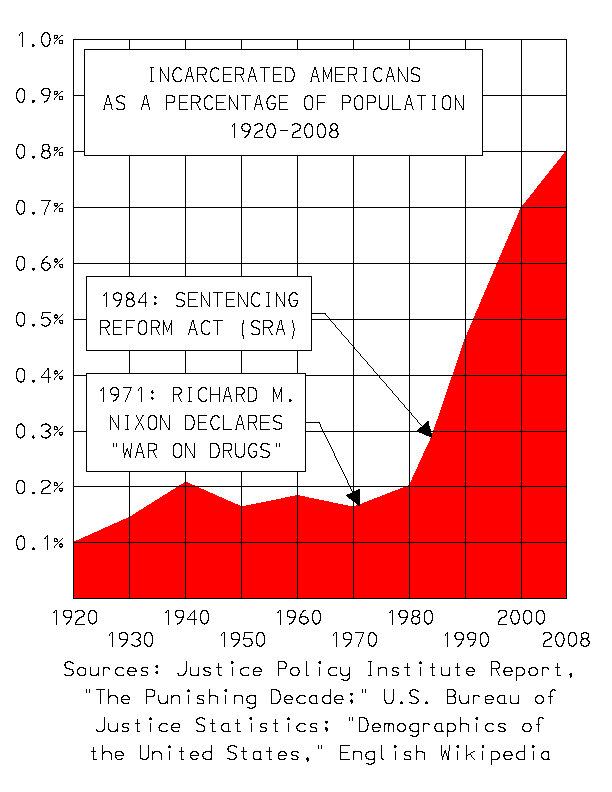
Last week, the Global Commission on Drug Policy published their Report which argues that a "War on Drugs" policy is an inefficient use of public resources.  The commission is an impressive group (which includes, among others, Kofi Annan, Paul Volcker and Richard Branson) but the report has been [predictably] rejected by leaders in the US and Mexico (despite the comission being convened by Latin American leaders that include former Mexican President Ernesto Zedillo).  I was intrigued by the fact that these leaders were explicitly trying to maximize social welfare subject to budget constraints, so I took a look for myself.  I particularly appreciate the report's first "principle":
Drug policies must be based on solid empirical and scientific evidence. The primary measure of success should be the reduction of harm to the health, security and welfare of individuals and society. 
In the 50 years since the United Nations initiated a truly global drug prohibition system, we have learned much about the nature and patterns of drug production, distribution, use and dependence, and the effectiveness of our attempts to reduce these problems. It might have been understandable that the architects of the system would place faith in the concept of eradicating drug production and use (in the light of the limited evidence available at the time). There is no excuse, however, for ignoring the evidence and experience accumulated since then. Drug policies and strategies at all levels too often continue to be driven by ideological perspectives, or political convenience, and pay too little attention
to the complexities of the drug market, drug use and drug addiction....  
click to enlarge
This reminds us that drug policies were initially developed and implemented in the hope of achieving outcomes in terms of a reduction in harms to individuals and society – less crime, better health, and more economic and social development. However, we have primarily been measuring our success in the war on drugs by entirely different measures – those that report on processes, such as the number of arrests, the amounts seized, or the harshness of punishments. These indicators may tell us how tough we are being, but they do not tell us how successful we are in improving the ‘health and welfare of mankind’.
I found the report thoughtful and the overall conclusions eerily reminiscent of John D. Rockefeller Jr.'s 1932 remark during Prohibition
When Prohibition was introduced, I hoped that it would be widely supported by public opinion and the day would soon come when the evil effects of alcohol would be recognized. I have slowly and reluctantly come to believe that this has not been the result. Instead, drinking has generally increased; the speakeasy has replaced the saloon; a vast army of lawbreakers has appeared; many of our best citizens have openly ignored Prohibition; respect for the law has been greatly lessened; and crime has increased to a level never seen before.
and reflected in this simple wikipedia graph


I don't think any of this is surprising to economists.  The demand for drugs is highly inelastic, so prices will rise dramatically if supply is restricted.  The burden of "taxation" (in this case, the energy the drug industry must expend to evade tough policies) is easily passed from suppliers onto consumers in the form of higher prices.  No surprises here, just basic principles from public finance.

Below are the key findings of the report.
Our principles and recommendations can be summarized as follows: 
End the criminalization, marginalization and stigmatization of people who use drugs but who do no harm to others. Challenge rather than reinforce common misconceptions about drug markets, drug use and drug dependence.

Encourage experimentation by governments with models of legal regulation of drugs to undermine the power of organized crime and safeguard the health and security of their citizens. This recommendation applies especially to cannabis, but we also encourage other experiments in decriminalization and legal regulation that can accomplish these objectives and provide models for others.

Offer health and treatment services to those in need. Ensure that a variety of treatment modalities are available, including not just methadone and buprenorphine treatment but also the heroin-assisted treatment programs that have proven successful in many European countries and Canada. Implement syringe access and other harm reduction measures that have proven effective in reducing transmission of HIV and other blood-borne infections as well as fatal overdoses. Respect the human rights of people who use drugs. Abolish abusive practices carried out in the name of treatment – such as forced detention, forced labor, and physical or psychological abuse – that contravene human rights standards and norms or that remove the right to self-determination.  
Apply much the same principles and policies stated above to people involved in the lower ends of illegal drug markets, such as farmers, couriers and petty sellers. Many are themselves victims of violence and intimidation or are drug dependent. Arresting and incarcerating tens of millions of these people in recent decades has filled prisons and destroyed lives and families without reducing the availability of illicit drugs or the power of criminal organizations. There appears to be almost no limit to the number of people willing to engage in such activities to better their lives, provide for their families, or otherwise escape poverty. Drug control resources are better directed elsewhere.

Invest in activities that can both prevent young people from taking drugs in the first place and also prevent those who do use drugs from developing more serious problems. Eschew simplistic ‘just say no’ messages and ‘zero tolerance’ policies in favor of educational efforts grounded in credible information and prevention programs that focus on social skills and peer influences. The most successful prevention efforts may be those targeted at specific at-risk groups.

Focus repressive actions on violent criminal organizations, but do so in ways that undermine their power and reach while prioritizing the reduction of violence and intimidation. Law enforcement efforts should focus not on reducing drug markets per se but rather on reducing their harms to individuals, communities and national security. 
Begin the transformation of the global drug prohibition regime. Replace drug policies and strategies driven by ideology and political convenience with fiscally responsible policies and strategies grounded in science, health, security and human rights – and adopt appropriate criteria for their evaluation. Review the scheduling of drugs that has resulted in obvious anomalies like the flawed categorization of cannabis, coca leaf and MDMA. Ensure that the international conventions are interpreted and/or revised to accommodate robust experimentation with harm reduction, decriminalization and legal regulatory policies.

Break the taboo on debate and reform. The time for action is now. 


10.29.2010

Prison privatization, political economy, and interest group creation


NPR has a great ongoing series exploring how privatization can have extraordinary externalities, namely the role of private prisons in the drafting of Arizona's immigration law:
Thirty of the 36 co-sponsors received donations over the next six months, from prison lobbyists or prison companies — Corrections Corporation of America, Management and Training Corporation and The Geo Group.

By April, the bill was on Gov. Jan Brewer's desk.

Brewer has her own connections to private prison companies. State lobbying records show two of her top advisers — her spokesman Paul Senseman and her campaign manager Chuck Coughlin — are former lobbyists for private prison companies. Brewer signed the bill — with the name of the legislation Pearce, the Corrections Corporation of America and the others in the Hyatt conference room came up with — in four days.

Brewer and her spokesman did not respond to requests for comment.
This is an excellent example of why economics is both an extraordinary tool for analysis but also one that is easily abused. The primary argument for privatization almost always comes down to one of efficiency: the public sector is slow, it's bloated, taxpayers pay $1000 for toilet seat installation, etc. That is not a concern to be belittled, and removing all constraints and checks from public sector workers is clearly a horrible idea.

But the flip side is that there are deep political economy concerns any time you privatize the provision of a public good. The incentives society as a whole faces (i.e., let's *not* incarcerate everyone all the time) are the exact opposite of what a for-profit prison faces (from the article: "They talk [about] how positive this was going to be for the community," Nichols said, "the amount of money that we would realize from each prisoner on a daily rate."). Since politicians respond to incentives, too, and for-profit companies have money to spend on campaign donations, political ads, etc., an already difficult problem is made much more complex (and, I'd argue, welfare decreasing) by following a simple welfare-enhancing efficiency argument.

Now, the flip side of the flip side (since I doubt most people reading a "sustainable development" blog are hungering for privatization) is that the same argument applies for all organized interest groups, not just private ones. This is very similar to the classic argument against unions, for example: New York's widely disliked (even by a lot of teachers) United Federation of Teachers is able to exert a huge amount of political pressure to support policies that are almost certainly harmful to educational outcomes, e.g., making firing bad teachers extraordinarily hard. The problem is the same: once an interest group comes into existence it will do its best to influence policy in its favor.

So what do we do? Legitimately, I think the two solutions are the obvious, difficult ones: transparency in campaign finance and mobilization of counter-interest groups. The first is hard for all of the obvious reasons (including most organized interest groups being against it) and the second is hard because often the counter-interest faces not just asymmetric funding (there's no private interest in keeping people *not* in prisons) but also a fundamental public goods problem: damages tend to be dispersed and costs of abatement concentrated, so anyone joining the counter-interest is either going to be doing it altruistically (e.g., a non-profit), because they were one of the unlucky few who got hit with particularly concentrated damages (e.g., the family of someone unjustly imprisoned), or because they reap some metabenefit (e.g., the NPR reporters covering this story) .

Which is to say, surprise, it's a fairly intractable and complex problem. If there's a lesson to extract I think that it is, as it so often seems to be, to always think about how incentives align, especially before you make large, difficult-to-reverse decisions. In particular, I think it's important to remember that creating a monied interest group is one of the most difficult-to-reverse decisions there is.

10.11.2010

African maritime infrastructure


A recent article by Michael Lyon Baker in Foreign Affairs make an unconventional but interesting point: African maritime ports are in bad shape and this produces a bottleneck for trade and economic growth.
Africa has the least efficient ports in the world. Dwell times -- the amount of time a ship must stay in port -- for the loading and unloading of cargo exceed global averages by several days and are nearly quadruple those of Asian ports, thus driving up shipping costs through delays. No African port can be found on the list of the top 70 most productive in the world. As a result, shipping companies send smaller, older, and cheaper ships to Africa in an effort to reduce their losses.
A number of factors are to blame: poor harbor maintenance, bureaucratic red tape, inadequate maritime law enforcement, and lax security....
Baker points out that poor infrastructure in ports means that shipping companies reallocate their fleet in such a way that further slows trade:
Moreover, many African ports cannot handle ships of median size due to infrastructure limitations. Meanwhile, the global shipping industry has been modernizing its fleets, scrapping obsolete vessels for newer mega-carriers. This means that shipping companies will continue deploying their remaining smaller and slower ships for transport to and from Africa.... In this environment, companies producing goods in Africa cannot reliably or efficiently get their wares to market. This plays a large role in explaining why Africa garners only 2.7 percent of global trade despite its cheap labor force, cheap commodities, and proximity to major markets.
However, if governments really want to get shipping companies to use their bigger and better ships in Africa, it is probably the case that infrastructure and market opportunities would need to not only improve, but surpass opportunities elsewhere (such as China).  This may not be realistic.

Probably too much of the article focuses on piracy, but his mention of labor market opportunities seems to agree with many of the things we know about predation:
A crucial means of countering piracy, oil theft, narcotics trafficking, and terrorism along the African coast is creating better job opportunities. Development approaches usually focus on land-based projects such as agriculture. To be sure, African states need to attract investors for manufacturing companies, but they must also entice shipping companies to get those goods to market. The poor state of Africa’s maritime sector is the most important factor stifling the continent’s growth.
I think it is extremely interesting to think about African maritime infrastructure, because Baker is right that most of the policy focus in Africa is land-based. Although I'm not sure we have enough evidence that dilapidated ports are the "most important factor" for African development. It is notoriously difficult to pin down the effects of infrastructure on economic development since infrastructure is frequently developed in response to increasing demands, itself a result of development.

8.28.2010

A new mechanism to consider when measuring climate impacts on economies

[A shorter (and more heavily copy-edited) version of this post was published in EARTH Magazine, read it here.]

My paper Temperatures and tropical cyclones strongly associated with economic production in the Caribbean and Central America was recently published in the Proceedings of the National Academy of Sciences. Because the paper is a little technical, here is a presentation of the results that everyone should be able to understand.

Following countries over time, years with higher than
normal temperatures during the hottest season 
(Sep-Oct-Nov) exhibit large reductions in output across  
several non-agricultural industries.
Central finding:
Economic output across a range of industries previous thought of as "not vulnerable to climate change" respond strongly to changes in temperature.  The data suggest that the response is driven by the direct human response to high temperatures: people generally are less productive and tire faster when it's hot.  This impact, which appears to be quite large, has not been factored into any previous estimates for the global cost of climate change.

Background
Governments and organizations around the world are trying to figure out how much money we should spend to avoid climate change.  The answer isn't obvious.  On the one hand, climate change seems ominous and we'd like to spend lots of money to avoid it. But on the other hand, if we spend money on avoiding climate change, we can't spend it on other important things. For example, imagine that the United Nations has a million dollars it can spend. Should it spend it on building solar panels or building schools?  Both are clearly important. But if we want to get the most "bang for our buck," we need to figure out what the benefits of these two types of investments are.

A whole research industry has sprung up around the cost-benefit analysis of preventing climate change.  How much money should be spent to prevent climate change by investing in more expensive low-carbon technologies? Who should pay for it and when should they pay for it?  A tremendous amount of intellectual machinery has been applied to this problem by many extremely smart people.  The basic approach is to build models of the world economy-climate system and try to see what happens to the climate and the economy under different global policies.  These models are used by governments around the world to determine what they think the best climate policies are and how much they should spend on the problem.

However, there is something of a dark secret to this approach: we don't really know what will happen to us if the climate changes.  We have a fairly good grasp of how much it might cost to implement different energy policies. And we've learned a lot about how different energy policies will translate into global climate changes.  But when it comes to figuring out how those climate changes translate into costs to society (both financial and non-monetary), we end up having to do a lot of guesswork.

It's unfair to say we know nothing about the costs of climate change, but what we understand well is limited to certain types of impacts.  For example, we have been doing extensive research on the possible agricultural impacts for years. We've also done studies for a lot of the health impacts.  But most research stops there.  For example, we only are beginning to learn about the effect of climate on people's recreation and perceived happiness.  We're also only beginning to learn about the effect of climate on violence and crime.  We know a lot (but not nearly everything) about the effect of climate on ecosystems, but we don't really understand how ecosystems affect us, so we still can't estimate this impact on society. The list goes on.

Now we know a lot about climate impacts on health and agriculture because people have studied those impacts a lot.  Why did we study those kinds of impacts so much? I'm not sure. Maybe because the importance of climate on health and agriculture is obvious (eg. my plants on the windowsill died after just two days of this summer's heat wave).

The fact that we only really understand agricultural and health impacts of climate change is very important in the cost benefit analyses I mentioned earlier.  When governments are trying to figure out the best policies, they add up the known costs of preventing climate change and they add up the known benefits of preventing climate change.   If the costs outweigh the benefits, then that suggests we shouldn't spend much money to stop climate change.  But there is a natural asymmetry in this comparison between costs and benefits: we know all (or most of) the costs but only know the health and agricultural benefits.  So when we add up the costs of energy policies, the numbers tend to look very big.  But when we add up the known benefits of those policies, we add up the health benefit and the agricultural benefits, but we have to stop there because we don't know what else will be affected by climate change.  Maybe it shouldn't be surprising that many cost-benefit analyses find that climate change is not worth spending a lot of money on.

But what we know about climate impacts in non-health and non-agricultural sectors is slowly improving.  In a 2009 working paper, Dell, Jones and Olken did something very simple and got very surprising results.  They compared the economic output of countries over time with year-to-year changes in the weather of those countries.  They found that in poor countries, small increases in the annual average temperature of a country lead to large drops in economic output of that country.  The approach sounds simple, right? It is.  But the results are startling because they found such a large effect of temperature. They estimate that a 1C increase in average temperatures decreases a poor country's gross domestic product (GDP) by 1.1% in the same year. To get a sense of how big this effect is, recall that the economy of the Unites States shrank by 2.4% in 2009 and people are upset about the state of the economy.

Because the effect found by Dell et al. is so large, many people have been skeptical that it represents something real (note from my own unpublished work: I can corroborate their results using different data sets from the ones they used).  To check these results further, in 2010, Jones and Olken tried to looking for a similar effect in the exports of these countries and found that they also responded strongly to temperature changes.  Do people believe the general result yet? I'm not sure.  But part the skepticism seems to persist because its hard to know why poor countries should be so strongly affected by temperature.  One reason for this is that it's very hard to know what mechanisms are at work when one is only looking at macro-economic data.  Further, thinking of ways in which temperature affects economics this strongly and systematically across countries seems to be hitting the limits of many peoples' imaginations. This is where my study comes in.

7.29.2010

Revisiting Project Star and the Long-Term Impacts of Educational Interventions


Some big news in educational economics came out this week with a team of economists including Raj Chetty and Emmanuel Saez releasing some pretty groundbreaking results on the long-term impacts of Tennessee's Project Star. Slides from the talk where the results were presented are here. The New York Times has a pretty good overview here. Project Star is pretty well known in economics as it was one of the first big purposely randomized education experiments. Students were randomly placed in classes with different numbers of students to try and tease out whether class size had an effect on educational outcomes ("Star" pithily stands for "Student Teach Achievement Ratio"). It famously found that (a) effects were there in the intuitive sense, i.e., students in smaller classes did better on standardized exams, the metric of choice, but (b) those effects trailed off over time.

What Chetty, Saez and their coauthors do (which I think captures pretty nicely the sort of economics that sends a tingle of cleverness-excitement up my spine) is match students who were in the Star experiment with their tax records to get long term earning data. Two things are particularly cool about this. The first are the results themselves. They find that not only are class size effects important in the long run but teacher quality effects and (even more robustly) class quality effects have very measurable long-term impacts on latter life earnings and college attainment / achievement rates, even when those effects take place in kindergarten. If you want the terrifyingly strong result, check out slides 44 and 49 in the pdf. Moreover, they go back and show that test scores, which everyone agrees are only a proxy for what we actually care about, do a fairly nice job of predicting how people will do later on, providing some validity to programs that measure their impact by how well students do on exams. Whether that should be exciting or troubling is, I think, a pretty deep question.

The second thing that's cool about it is that it sets out to find long-term, indirect, but ultimately very important effects in a very picked-over area of research (Star has been written about a *lot*). The education literature has long been one of the main sources of new applied econometric technique, which is why someone like me whose research has very little to do with education knows about things like Tennessee Star or class size cutoffs in Israel. So the precedent this sets, which is basically "sometimes the effects we care about are 20 years down the line and not in the original area we were looking at" comes in a heavily trafficked area of research with both rich existing precedent and a lot of sway over other areas of applied research. Which obviously makes me happy, since that same precedent can be thought of as applying to a lot of the environmental, health, and public goods questions that we concern ourselves with in sustainable development-related research.

Anyway, if you have a second read the Times article or, even better, flip through the slides (they're pretty clean and approachable and have some great graphs). Then go teach a five year old something new.

6.20.2010

Iceland, Freedom of Expression, and Institutional Competition


Iceland's Althing* just passed a resolution that was being heavily pushed by Julian Assange, the founder of Wikileaks (and recently profile-ee of the New Yorker, here) that seeks to make Iceland's protection of freedom of expression, especially over the internet, the strongest in the world.

Now, there are multiple ways of thinking about why this was done (that it's an attempt to bring international accolades to a country that's been rather macroeconomically embarrassed of late doesn't seem out of the realm of possibility...) but what I find most interesting about is that it's yet another example of traditionally noneconomic things getting some very economic treatment. The language that's been used to cover the bill thus far has been quite evocative of another form of "institutional competition," namely tax havens. It's fairly conceptually similar to the way that places like the Caymans Islands have decided to give themselves comparative advantage among investors by setting low tax laws and regulations that encourage the creation and hassle-free maintenance of off shore investment vehicles.

Yes, there's a fundamental information asymmetry difference here in that freedom of expression is, by definition, observable, so unless they do it anonymously dissidents from other countries will only be protected from Iceland's laws, which is probably not what they're worrying about in the first place. That does make it a lot less attractive than the knowledge that I could dump some ill-gotten gains in a numbered account in Lichtenstein and never have it get found, taxed, or linked to my ill-getting, but nonetheless. The decision to institutionally compete is there, and I'm curious to see how it'll pan out and whether it'll have any material effect.

Now all we need is a greater degree of institutional differentiation and a reduction in migration barriers and we can get some megascale Tiebout sorting. Lower taxes for Russian-style restrictions on free speech, anyone?

* I feel like somewhere there's an undergrad viking mythology professor who's very happy I'm linking to the webpage of the oldest parliamentary institution in the world. And no, I can't read Icelandic. But Google Chrome does have Google Translate built in...

6.17.2010

Risk Denialism and the Costs of Prevention


Sol's posts about the BP oil spill (here and here) got me thinking a little bit about the interplay between denialism and risk and how deeply related that is to the sprawling mess of concepts we put under the umbrella of "sustainable development."

One of the major themes in the coverage of the spill has been how poorly equipped BP was to deal with a spill of this magnitude. Now, regardless of your opinion of BP as a company, ex-post this is a bad thing. BP would much rather, right now, be known for its quick, competent and effective response to a major catastrophe than be roundly (and for that matter, rightly) villainized. They've lost about half their market cap since the spill happened, and now they have to set up a $20 billion clean up escrow account. Why weren't they better prepared?

There are a few potential answers to that. The spill's magnitude may simply have been completely unforeseeable, a "Black Swan" -style event that BP can be forgiven for not anticipating the same way New Yorkers can be forgiven for not buying tornado insurance. Or perhaps, net of prior cost-benefit analysis, the probability of a spill this big was so low compared to the cost of maintaining intervention equipment that BP decided to skimp on it, akin to how most New Yorkers spurn flood or wind insurance despite the fact that hurricanes intermittently hammer the city. But the answer that now seems most likely is that that there was a fundamental disconnect between what the rig workers told upper management (internal BP documents refer to it pre-spill as a "nightmare") and what upper management told them to do. This is akin to New Yorkers not buying renter's insurance after they've been told the burglary rate in their neighborhood is quite high.

What I find interesting about this is how closely the framework of this story jibes with so many of the other narratives in environment and development. A group of technically trained experts warns of a potentially catastrophic risk (climate change, overfishing, pandemic flu) only to have their warnings discarded by cost-bearing decision makers (politicians, corporate executives, voters) who deny that the risk is as great or even extant. In these scenarios, it's not that the decision makers wouldn't face massive costs should they turn out to be wrong, it's that there's a big difference between what their behavior indicates they think the probability of facing those costs is and what they're being told by technical advisors.

Why? Well, it seems that cost-bearing seems to have a very strong influence on how someone interprets difficult-to-verify information about risks, especially social / shared risks. In psychology this is known as the defensive denial hypothesis and there's a fair bit of empirical evidence to support it. The BP managers tasked with running the platform knew the immediate costs of reducing flow, or stopping drilling, or increasing safeguards, and it seems highly likely that this influenced how they interpreted warnings from the rig workers. The same sort of phenomenon seems to occur in a lot of other areas: fishermen are more sanguine about the risks of overfishing, oil executives downplay the risk of climate change, and derivatives traders claim that their activities are nowhere near dangerous enough to warrant regulation. Now, many other factors are clearly at stake in all of these, from discounting to strategic maneuvering to cheap talk, but given the genuineness with which deniers of, say, climate change argue their case, it seems difficult to say that they are not at least somewhat personally convinced that their interpretation of the evidence is correct.

Now that on its own isn't terribly revelatory, but when you combine it with the notion that perceptions of costs can be subject to manipulation as well, you get an interesting result. The more (or less) salient a risk's mitigation cost is made, the lower (or higher) people come to view the probability of that risk. Witness, for example, the repeated attempts to link efforts to combat climate change to personal tax burden by those who think (or claim to think) that it's a bogus risk. This may not even necessarily be an actual cost: the Jennifer McCarthy- led trend in parents refusing to vaccinate their children (leading to the actual risk of polio, measles, etc.) seems to be almost entirely a function of parents being led to believe that there is a potential cost to vaccination (possible autism) that is not supported by scientific evidence. BP's managers faced the immediate and salient costs of risk mitigation steps that they'd need to justify to highers-up and behaved in a way that seems to indicate that they didn't think the risk of a major industrial accident was worth fretting over.

So what? I think the lesson here is that while risk denial is often depicted as stemming from short-sightedness, or ignorance, or political zealotry, it's actually pretty common human behavior. People have preferences and like to align their behavior appropriately, and if that means that they have to subconsciously alter their assessments of how dangerous some far off activity may be, they'll do so. If we are concerned about arresting climate change, or preserving biodiversity, or managing natural resources, then it's important to keep in mind that the way people perceive the incidence of the cost of mitigation will not only affect their preferences in terms of raw cost-benefit analysis, but also legitimately move their perception of the riskiness of their behavior. If we want political support for efforts to deal with these sort of risks, it thus seems similarly important to find and then emphasize ways in which the costs can be made low and painless as it is to stress the potential for future damages.