Showing posts with label books. Show all posts

4.12.2013

Bruce Hansen's Econometrics textbook

Dave Giles over at Econometrics Beat points out that the new version of Bruce Hansen's Ph.D.-level econometrics textbook is now available. It's freely available as a pdf in both standard and iPad formattings, and flipping through it a bit it seems to be quite readable. I particularly like the opening quote from Ragnar Frisch, first editor of Econometrica and, apparently, progenitor of the term "econometrics":

"[T]here are several aspects of the quantitative approach to economics, and no single one of these aspects, taken by itself, should be confounded with econometrics. Thus, econometrics is by no means the same as economic statistics. Nor is it identical with what we call general economic theory, although a considerable portion of this theory has a definitely quantitative character. Nor should econometrics be taken as synonymous with the application of mathematics to economics. Experience has shown that each of these three view-points, that of statistics, economic theory, and mathematics, is a necessary, but not by itself a sufficient, condition for a real understanding of the quantitative relations in modern economic life. It is the unification of all three that is powerful. And it is this unification that constitutes econometrics."

Topics covered are below the fold.

12.19.2012

If scientists had a Book of Psalms, it would be this book

While wandering through the Princeton bookstore, I stumbled upon this gem. The Oxford Book of Modern Science Writing by Richard Dawkins will become a treasure of the scientific community. Dawkins gathers 83 choice writing excerpts from the "Greats" of scientific writing (e.g. Pinker, Diamond, Turing, Einstein, Sagan, Penrose, Greene, Hawking, Chandrasekhar, Sacks, Oppenheimer, Wilson, Carson, Dyson, Snow... the whole list is here). The excerpts are each short (a few pages) but masterfully chosen, and Dawkins provides a brief discussion of each writer and their style before presenting the text.  The selected excerpts discuss many of the central philosophical questions/insights of science, as well as many of its key contributions -- so readers are educated about actual science in addition to seeing how to write about it beautifully.

The book is thick, and I haven't finished it myself, but I can't recommend it enough for anyone who considers themselves a scientist.  If science were art, this text would be like a distillation of the best masterworks from the world's best museums into a potent liquor that makes you feel guilty when you read from it because it is so rich and amazing -- representing much of humanity's collective accomplishments -- and undeservingly, you're still just sitting on your couch.

If you're looking for a holiday gift for a scientist, I would recommend this. Or if you're a scientist whose annoyed that your loved ones didn't buy you this book for the holidays, you can read a lot of it for free on google here.

An aside: If I ever get the chance, I hope to lead a seminar/clinic for phd students on scientific communication.  I think this book on writing will round out the curriculum alongside Tufte's book on data display and Baron's book on communicating verbally.

5.08.2012

Read this book!

So you have an extra 23 dollars and a few hours to fill? My recommendation: change your life and read this book.

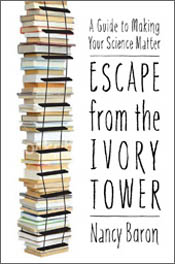
Steven Gaines recommended "Escape from the Ivory Tower" (by Nancy Baron) to me and it has made me a better communicator, a better writer, and probably a better researcher.

Baron is a scientist-turned-science-writer and puts together a quick read that helps us awkward and detail-oriented scientists pretend that we are smooth operators doing research that everyone should care about.

The book basically has two components. First, she helps you understand how journalists, policy-makers and normal humans see the world and, more importantly, how they think about scientific research. This alone helped me dramatically improve how I frame my work.

Second, she then lays out a whole bunch of practical tools to help you think through how you should present your research, from how to structure a paper summary to how to handle telephone/TV interviews and what to expect when talking with policy-types.

And since Baron is a pro on writing, the book is an unsurprisingly snappy and entertaining read full of excellent quotes.

I can't recommend this book enough. If I ever get the chance to teach a class on research methodology, I swear that I will require that everyone read this book.

Other books in the make-yourself-a-better-communicator series: graphics and climate.

4.25.2012

Background reading on global institutions

Reading about recent cases in the international criminal court, I realized that I don't actually know much about how the court really functions.  So I went looking for a primer on the ICC and found something in the "Global Institutions Series" published by Routledge (and subsequently remembered that I wanted to blog this series a while back).

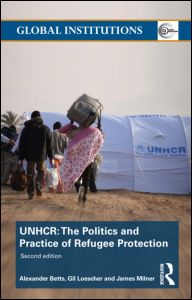
I discovered this series when I went looking for background reading on how the UNHCR functions.  I found this book by Loescher et al (pictured), which gave a comprehensive background of the institution in a concise 130 pages (useful for us busy folk).  On the inside flap is a list of other volumes that have been assembled, covering institutions from the WHO and the IMF to the International Olympic Committee (see the complete list here).  They seem like an imminently practical resource and I've ordered a few more. I may even end up using some in future classes.  (FE readers might be interested in the volume on global environmental institutions, which I found in a free online PDF here).  The series began in 2005, so some of the volumes might be missing the most recent debates. But for the historical context of these institutions, many of which formed around mid-century (last century), I don't think that should matter much.

This is the publisher's summary of the series:
The "Global Institutions Series" is edited by Thomas G. Weiss (The CUNY Graduate Center, New York, USA) and Rorden Wilkinson (University of Manchester, UK) and designed to provide readers with comprehensive, accessible, and informative guides to the history, structure, and activities of key international organizations as well as books that deal with topics of key importance in contemporary global governance. Every volume stands on its own as a thorough and insightful treatment of a particular topic, but the series as a whole contributes to a coherent and complementary portrait of the phenomenon of global institutions at the dawn of the millennium. 
Books are written by recognized experts, conform to a similar structure, and cover a range of themes and debates common to the series. These areas of shared concern include the general purpose and rationale for organizations, developments over time, membership, structure, decision-making procedures, and key functions. Moreover, current debates are placed in historical perspective alongside informed analysis and critique. Each book also contains an annotated bibliography and guide to electronic information as well as any annexes appropriate to the subject matter at hand.

11.08.2011

Open access textbooks

Want to increase access to tertiary education but don't have lots of cash on hand for increasing your stock of educational materials? I recently met with the CTO of boundlessnow.com and they have an elegant solution to this problem: organize pre-existing open source content (eg. wikipedia) into textbook form and make access to students free.

As a bonus, the textbooks are organized to reflect the structure of pre-existing textbooks, so students unable to afford expensive textbooks can read the same material that their professor assigns to the rest of the class.  But I can imagine professors [particularly in low/middle-income, but highly-networked, countries] simply assigning the Boundless version of the textbook rather than bothering with lip-service to the original publication.

Some impressive points from their FAQs

How are Boundless Textbooks Made?Boundless Textbooks are created in a 3-step process:
  • We curate the highest quality open source educational content and vet it with our team of top educational professionals from Harvard, MIT, Columbia, UC Berkeley, and other top institutions.
  • We serve the open source educational content to cover the same material and concepts you are covering in your class and assignments.
  • We make your Boundless Textbook digitally available from any computer at anytime and integrate the ability to instantly share notes, highlights and more with classmates and friends. 
Do Boundless textbooks cost any money?No. Boundless Textbooks are 100% free. 
How long do I get access to Boundless Books?You get universal access to your Boundless textbooks for life. There are no rental periods or other limitations. 
How are the books free?Over the past 15 years, leading individuals and institutions, including MIT, Rice, Yale, and others, have begun releasing high quality educational content for others to use. This content is know as “Open Educational Resources (OER)”. 
Recently, various state governments and the US government have begun investing Billions of dollars to continue creating more high quality open content (yes, that’s Billions with a B). 
The Boundless Team organizes, edits and improves this content so that students can access the exact material that they need, whenever they need it.

Coupled to projects like OLPC, efforts like this could have big impacts on primary and secondary education as well.

7.20.2011

Make better graphs

I rarely actually finish reading books. But when I do it means they're useful and interesting, so I'll tell you when that happens.

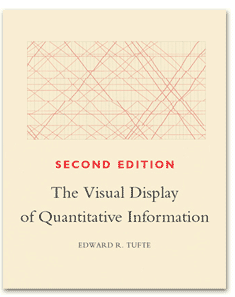
I finally finished Tufte's famous The Visual Display of Quantitative Information (here on Amazon).  There are gazillions of reviews online, so I'll be brief.

If you are an applied researcher and you plan on making your living doing statistics or theory and writing papers, ask each of your colleagues for $1 so you can buy and read this book.  They will gladly pay up, since it will make deciphering your future papers much more pleasant.

The book is overpriced and Tufte's writing style is patronizing. But the book is still worth reading and if I ever teach a stats class, it will be assigned.  If the book does nothing else, it brings together a wide array of statistical graphics from various fields, graphs I never would have found on my own, and critiques them.  The critiques sound like the kind of thing that photographers, artists and designers do for each other all the time.  But its uncommon for us stats-types to ever really talk about the organization and aesthetics of our graphs. I was surprised how useful the exercise was for me.

Tufte is a designer and he names his rules-of-thumb-for-graphs things that only a designer would come up with.  But he's not dumb and this is a book for applied statisticians.  He doesn't do any fancy math, but he assumes you know what variance, a marginal distribution and r-squared are on page 2.

If you pride yourself on being a pragmatist with no taste for unnecessary glitz, you may be surprised to find that Tufte-the-designer is on your side.  All of his tools and tips help you focus on the data and avoid unnecessary decorations in your graphs.  He even critiques several of the "recommended graph styles" used in top journals as being over-drawn.

Recommendation: buy the book and read it.  It's easy to read and will make all of your future work more valuable.  Constructing a single smoking graph as the centerpiece in each paper/presentation is one of the most useful things you can do as a researcher.  And this book will help you get there.  I didn't like all of his advice, but I'm certain that he altered how I approach my own graphs (and I'm someone who already spent a lot of time thinking about their design).

Besides, even if you end up hating the book, at least you can appreciate its beauty: it's probably the only statistics book that I would consider leaving out on the coffee table when guests are over.

7.16.2011

The Psychology of Climate Change Communication

This looks useful: The Psychology of Climate Change Communication: A Guide for Scientists, Journalists, Educators, Political Aides, and the Interested Public

Download a PDF of the book for free here.

The book is put together by a group here at Columbia: the Center for Research on Environmental Decisions (CRED).  I saw a flyer for it today while at a seminar they were hosting on rainfall index insurance. Here's what J. Sachs has to say about it:

“The ultimate solutions to climate change are workable, cost-effective technologies which permit society to improve living standards while limiting and adapting to changes in the climate. Yet scientific, engineering, and organizational solutions are not enough. Societies must be motivated and empowered to adopt the needed changes.  
For that, the public must be able to interpret and respond to often bewildering scientific, technological, and economic information. Social psychologists are aware, through their painstaking scientific research, of the difficulties that individuals and groups have in processing and responding effectively to the information surrounding long-term and complex societal challenges.  
This guide powerfully details many of the biases and barriers to scientific communication and information processing. It offers a tool—in combination with rigorous science, innovative engineering, and effective policy design—to help our societies take the pivotal actions needed to respond with urgency and accuracy to one of the greatest challenges ever faced by humanity: global-scale, human-induced environmental threats, of which the most complex and far reaching is climate change.”  
—Jeffrey Sachs, Director, The Earth Institute, Columbia University

7.13.2011

Doctors Without Borders: lessons learned

This looks like a really interesting new publication by the Nobel Prize winning organization MSF. Download the book in pdf form for free here.
"Medical Innovations in Humanitarian Situations explores how the particular style of humanitarian action practiced by Doctors Without Borders/Médecins Sans Frontières (MSF) has stayed in line with the standards in scientifically advanced countries while also leading to significant improvements in the medical care delivered to people in crisis. 
Through a series of case studies, the authors reflect on how medical aid workers dealt with the incongruity of practicing conventional evidence-based medicine in contexts that require unconventional approaches."

6.23.2011

Ideology in science

"In science, ideology tends to corrupt; absolute ideology [corrupts] absolutely"
-Robert Nisbet

That's from Mukherjee's Emperor of All Maladies, a remarkably in depth and fascinating book on the history of cancer and our attempts to treat it. That quote starts out the section detailing the push towards more empirically grounded treatments and away from surgeon preference and beliefs. Like much of the rest of the book, it manages to be frustrating, compelling, inspirational, and heart breaking all at once.

I'm finishing it up now and recommend it highly, even if your interest in oncology (or the life sciences, for that matter) is only passing. Mukherjee's subtitle is "A Biography of Cancer," but it is as much a biography of oncology itself, and all the foibles, hyped enthusiasm, and ideologically-driven resistance to change come across as uncomfortably familiar to someone working across fields.

On a side note: is it just me or does scientific writing by medical doctors sound and feel fundamentally different from all other scientific writing? It might be the reliance on narrative and case study, or it might simply be the tone; regardless, it always feels very "doctor-y" to me...

5.03.2011

Al Gore's "Our Choice" app

By chance, I ran across across Al Gore's new high profile ipad/iphone app. Its a new kind of ebook (which presents the material from his paper book with the same title) where interactive graphics, maps, movies and data visualizations are all embedded in the text.  After browsing it for just a few minutes, it becomes clear that it deserves the praise it's been getting for its innovation in design (regardless of whether or not you agree with its message).  For complex multidimensional problems, like global climate change, getting an average person up to speed on the issues is costly.  Design like this can help reduce this cost and get more people involved in the discussion in a meaningful way.  For someone who wants a rapid and concise intro to the issues [and is willing to tolerate a few subjective/political interpretations of the issues], this is a fun way to go.  You can download it here for $5. Trailer videos below.


4.20.2011

Karlan and Appel's "More Than Good Intentions"


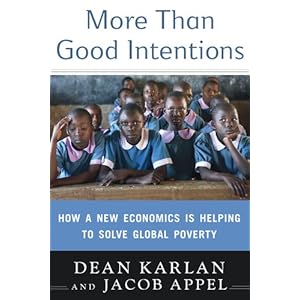
Dean Karlan and Jacob Appel's new book More Than Good Intentions (previously mentioned here) is coming out tomorrow and Sol and I got a hold of review copies. To that end, a review:

Overall it's a great read. Karlan does behavioral development economics with a big emphasis on Poverty Action Lab-style randomized control trials, and the book is essentially a thematicized overview of the current state of that field. What's particularly worth noting is that behavioral development econ is very new: most of the papers and studies covered are from the last ten years (Googling around a bit turns up what I think is the earliest lit review from 2006), and as far as I can tell this is the first book on the subject at all.

That newness shows up in the general slant of the book. A lot of general-audience econ and science books tend towards pithy summaries of major results from the author's area of research (e.g., "libertarian paternalism works" or "clever identification can reveal crazy facts"). But the pithy summary of this book would probably be something like "psychology really affects economic outcomes in developing contexts, sometimes hugely, and here's some promising early evidence." There's less a grand thesis that's being hammered away at so much as a constellation of interesting data points all hinting at a new and interesting way to think about the fundamental problems of development.

Some of those seem very promising. The multiple sections on microfinance provide a lot of worthwhile food for thought, and Karlan & Appel's emphasis on the importance of providing microsavings as opposed to simply microcredit is particularly welcome. Other parts of the book on areas like agriculture, health, etc. seem to me almost as if they should be "behavioral" chapters in books on those subjects, which really is another way of saying that the field is young and there's a lot of research waiting to be done.

In short, the book was fun, engaging, and a quick read, and in combination with some background texts could probably could sub out for a nice undergrad class on behavioral development economics. I'd especially recommend it to high school and college students who are interested in development and trying to get oriented in the field / find out who the major players are / figure out which open problems are juiciest.

3.14.2011

pooreconomics.com

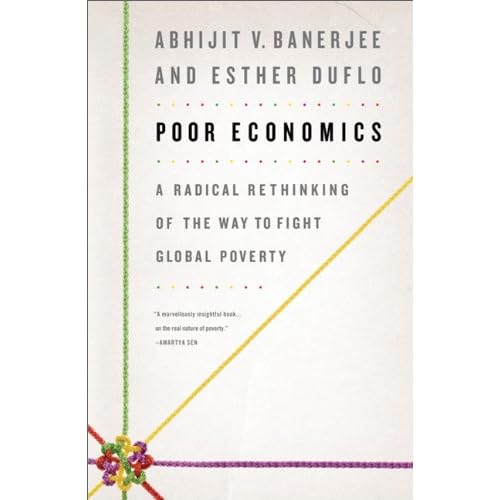
Abhijit Banerjee and Esther Duflo have put together what promises to be an excellent new book collecting the array of new advances made in development economics: Poor Economics.

The book isn't out yet, but its website sets a new standard for how academics present their work.  It has interactive maps, datasets and a collection of quality studies (each chapter has a long list of relevant reading).

Check it out: pooreconomics.com

2.17.2011

Map resources

I spoke with some librarians today who pointed me to two excellent online resources for historical maps, the University of Texas Map Library and the David Rumsey Map Collection.  There is so much untapped information on these sites its overwhelming.  Below were two favorites that I found on Rumsey's site.

The Distribution of Wealth, 1870

Ranking of States by Income, Debt, Literacy, etc, 1880


12.09.2010

War statistics to ponder

From Sebastian Junger's War :
Nearly a fifth of the the combat experienced by the 70,000 NATO troops in Afghanistan is being fought by the 150 men of Battle Company. Seventy percent of the bombs dropped in Afghanistan are dropped in and around the Korengal Valley. American soldiers in Iraq who have never been in a firefight start talking about trying to get to Afghanistan so that they can get their combat infantry badges.
The book is great, if a little disorganized. The movie which resulted from the footage Junger shot, Restrepo, is supposed to be phenomenal. More relevantly, the fact that so much of the fighting in Afghanistan was concentrated in this one strategically-not-very-important valley not only makes one wonder about the political economy of the military (that's the first time I've typed that phrase out but it sounds like it should be a field in its own right) but also about every other summary statistic I've heard about the wars in Iraq and Afghanistan.