Showing posts with label communication. Show all posts

4.15.2014

On giving a great applied talk

Jesse Shapiro* has some excellent slides on giving a good applied micro talk that are both specific enough to be of use for students prepping job market talks, as well as general enough to simply provide good fodder for thinking about how one presents one's work to any audience. I highly recommend them. (via Kyle Meng)


*: yet another Stuyvesant High School graduate.

12.19.2012

If scientists had a Book of Psalms, it would be this book

While wandering through the Princeton bookstore, I stumbled upon this gem. The Oxford Book of Modern Science Writing by Richard Dawkins will become a treasure of the scientific community. Dawkins gathers 83 choice writing excerpts from the "Greats" of scientific writing (e.g. Pinker, Diamond, Turing, Einstein, Sagan, Penrose, Greene, Hawking, Chandrasekhar, Sacks, Oppenheimer, Wilson, Carson, Dyson, Snow... the whole list is here). The excerpts are each short (a few pages) but masterfully chosen, and Dawkins provides a brief discussion of each writer and their style before presenting the text.  The selected excerpts discuss many of the central philosophical questions/insights of science, as well as many of its key contributions -- so readers are educated about actual science in addition to seeing how to write about it beautifully.

The book is thick, and I haven't finished it myself, but I can't recommend it enough for anyone who considers themselves a scientist.  If science were art, this text would be like a distillation of the best masterworks from the world's best museums into a potent liquor that makes you feel guilty when you read from it because it is so rich and amazing -- representing much of humanity's collective accomplishments -- and undeservingly, you're still just sitting on your couch.

If you're looking for a holiday gift for a scientist, I would recommend this. Or if you're a scientist whose annoyed that your loved ones didn't buy you this book for the holidays, you can read a lot of it for free on google here.

An aside: If I ever get the chance, I hope to lead a seminar/clinic for phd students on scientific communication.  I think this book on writing will round out the curriculum alongside Tufte's book on data display and Baron's book on communicating verbally.

8.31.2012

Watercolor regression

I'm in a rush, so I will explain this better later. But Andrew Gelman posted my idea for a type of visually-weighted regression that I jokingly called "watercolor regression" without a picture, so its a little tough to see what I was talking about. Here is the same email but with the pictures to go along with it. The code to do you own watercolor regression is here as the 'SMOOTH' option to vwregress. (Update: I've added a separate cleaner function watercolor_reg.m for folks who want to tinker with the code but don't want to wade through all the other options built into vwregress. Update 2: I've added watercolor regression as a second example in the revised paper here.)

This was the email with figures included:

Two small follow-ups based on the discussion (the second/bigger one is to address your comment about the 95% CI edges).

1. I realized that if we plot the confidence intervals as a solid color that fades (eg. using the "fixed ink" scheme from before) we can make sure the regression line also has heightened visual weight where confidence is high by plotting the line white. This makes the contrast (and thus visual weight) between the regression line and the CI highest when the CI is narrow and dark. As the CI fade near the edges, so does the contrast with the regression line. This is a small adjustment, but I like it because it is so simple and it makes the graph much nicer. 


My posted code has been updated to do this automatically.

2. You and your readers didn't like that the edges of the filled CI were so sharp and arbitrary. But I didn't like that the contrast between the spaghetti lines and the background had so much visual weight.  So to meet in the middle, I smoothed the spaghetti plot to get a nonparametric estimate of the probability that the conditional mean is at a given value:


To do this, after generating the spaghetti through bootstrapping, I estimate a kernel density of the spaghetti in the Y dimension for each value of X.  I set the visual-weighting scheme so it still "preserves ink" along a vertical line-integral, so the distribution dims where it widens since the ink is being "stretched out". To me, it kind of looks like a watercolor painting -- maybe we should call it a "watercolor regression" or something like that.

The watercolor regression turned out to be more of a coding challenge than I expected, because the bandwidth for the kernel smoothing has to adjust to the width of the CI. And since several people seem to like R better than Matlab, I attached 2 figs to show them how I did this. Once you have the bootstrapped spaghetti plot:


I defined a new coordinate system that spanned the range of bootstrapped estimates for each value in X 


The kernel smoothing is then executed along the vertical columns of this new coordinate system.

I've updated the code posted online to include this new option. This Matlab code will generate a similar plot using my vwregress function:

x = randn(100,1);
e = randn(100,1);
y = 2*x+x.^2+4*e;

bins = 200;
color = [.5 0 0];
resamples = 500;
bw = 0.8;

vwregress(x, y, bins, bw, resamples, color, 'SMOOTH');


NOTE TO R USERS: The day after my email to andrew, Felix Schönbrodt posted a nice similar variant with code in R here.

Update: For overlaid regressions, I still prefer the simpler visually-weighted line (last two figs here) since this is what overlaid watercolor regressions look like:


It might look better if the scheme made the blue overlay fade from blue-to-clear rather than blue-to-white, but then it would be mixing (in the color sense) with the red so the overlaid region would then start looking like very dark purple. If someone wants to code that up, I'd like to see it. But I'm predicting it won't look so nice.

7.20.2012

Less is more


There are many things we can do to make our research clearer to readers: make our text well organized and accessible, make clear graphs, consider the psychology of our readers, and use as little math as is necessary to explain our point.  Clarity and elegance trumps formalism and detail.


Intimidated by Equations?
Barbara R. Jasny
Although there is general agreement on the value of a strong tie between theory and data, forging links between theoretical and empirical approaches (and practitioners) is not as straightforward as it should be. New evidence of this disconnect comes from the work of Fawcett and Higginson, who examined the use of mathematical equations in 649 papers dealing with ecology and evolution that were published in 1998. They gathered citation data, excluding instances of self-citation. An increase in the number of equations per page of main text corresponded to a lower rate of citations. Overall, each additional equation in the main text of a paper was associated with a 28% decrease in the citation rate. Burying the equations in an appendix had a salutary effect on citation rate. When the citing papers were divided into theoretical and nontheoretical on the basis of their use of the word "model" in the abstract or title, the authors observed that the negative effect was due to the nontheoretical papers not citing papers with equations. There are caveats to the conclusions—examinations over longer periods of time, analysis of the relative content of the papers, and examination of the effect for online rather than print publication are all warranted. Although the authors conclude that better math education for biologists is the best long-term solution, they suggest that more immediate strategies could include the addition of explanatory text between equations.
The full PNAS article is here.

h/t Marshall Burke

5.08.2012

Read this book!

So you have an extra 23 dollars and a few hours to fill? My recommendation: change your life and read this book.

Steven Gaines recommended "Escape from the Ivory Tower" (by Nancy Baron) to me and it has made me a better communicator, a better writer, and probably a better researcher.

Baron is a scientist-turned-science-writer and puts together a quick read that helps us awkward and detail-oriented scientists pretend that we are smooth operators doing research that everyone should care about.

The book basically has two components. First, she helps you understand how journalists, policy-makers and normal humans see the world and, more importantly, how they think about scientific research. This alone helped me dramatically improve how I frame my work.

Second, she then lays out a whole bunch of practical tools to help you think through how you should present your research, from how to structure a paper summary to how to handle telephone/TV interviews and what to expect when talking with policy-types.

And since Baron is a pro on writing, the book is an unsurprisingly snappy and entertaining read full of excellent quotes.

I can't recommend this book enough. If I ever get the chance to teach a class on research methodology, I swear that I will require that everyone read this book.

Other books in the make-yourself-a-better-communicator series: graphics and climate.

12.08.2011

Political implications of perceived agreement on climate change

Support for climate policy and societal action are linked to perceptions about scientific agreement
Ding Ding, Edward W. Maibach, Xiaoquan Zhao, Connie Roser-Renouf & Anthony Leiserowitz
Abstract: Although a majority of US citizens think that the president and Congress should address global warming, only a minority think it should be a high priority. Previous research has shown that four key beliefs about climate change—that it is real, human caused, serious and solvable—are important predictors of support for climate policies. Other research has shown that organized opponents of climate legislation have sought to undermine public support by instilling the belief that there is widespread disagreement among climate scientists about these points—a view shown to be widely held by the public. Here we examine if this misperception is consequential. We show that the misperception is strongly associated with reduced levels of policy support and injunctive beliefs (that is, beliefs that action should be taken to mitigate global warming). The relationship is mediated by the four previously identified key beliefs about climate change, especially people’s certainty that global warming is occurring. In short, people who believe that scientists disagree on global warming tend to feel less certain that global warming is occurring, and show less support for climate policy. This suggests the potential importance of correcting the widely held public misperception about lack of scientific agreement on global warming.
I suppose this is more rational than this, but that's not saying much...

10.31.2011

A picture is worth a thousand lives

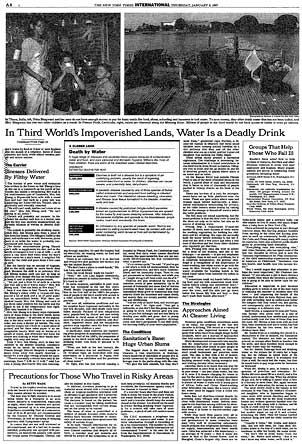
Kristof's article
I am a strong proponent of spending time on figures, tables and presentations so that important ideas are communicated clearly and succinctly.  The story of this  internal letter written by Nicholas Kristof to his colleagues at the New York Times is a good example of why.
From: Nicholas Kristof 
Subject: the power of art 
in september i traveled with bill gates to africa to look at his work fighting aids there. while setting the trip up, it emerged that his initial interest in giving pots of money to fight disease had arisen after he and melinda read a two-part series of articles i did on third world disease in January 1997. until then, their plan had been to give money mainly to get countries wired and full of computers. 
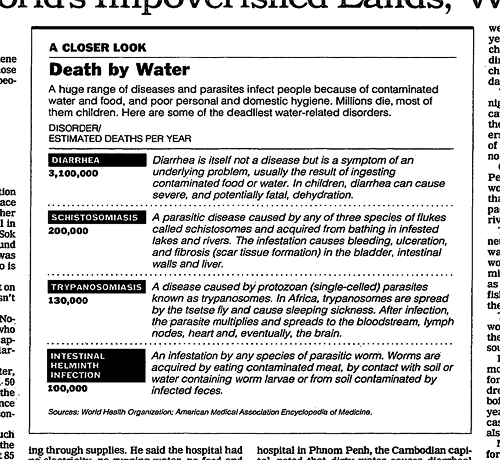
bill and melinda recently reread those pieces, and said that it was the second piece in the series, about bad water and diarrhea killing millions of kids a year, that really got them thinking of public health. Great! I was really proud of this impact that my worldwide reporting and 3,500-word article had had. But then bill confessed that actually it wasn't the article itself that had grabbed him so much -- it was the graphic. It was just a two column, inside graphic, very simple, listing third world health problems and how many people they kill. but he remembered it after all those years and said that it was the single thing that got him redirected toward public health. 
No graphic in human history has saved so many lives in africa and asia. 
I'm sending you a copy of the story and graphic by interoffice mail. whoever did the graphic should take a bow. 
nick kristof

The info-graphic/table that got Gates' attention.

Apparently, the letter itself is framed and hanging up in the office of the data graphics group at the NYT. h/t Pam.

7.16.2011

The Psychology of Climate Change Communication

This looks useful: The Psychology of Climate Change Communication: A Guide for Scientists, Journalists, Educators, Political Aides, and the Interested Public

Download a PDF of the book for free here.

The book is put together by a group here at Columbia: the Center for Research on Environmental Decisions (CRED).  I saw a flyer for it today while at a seminar they were hosting on rainfall index insurance. Here's what J. Sachs has to say about it:

“The ultimate solutions to climate change are workable, cost-effective technologies which permit society to improve living standards while limiting and adapting to changes in the climate. Yet scientific, engineering, and organizational solutions are not enough. Societies must be motivated and empowered to adopt the needed changes.  
For that, the public must be able to interpret and respond to often bewildering scientific, technological, and economic information. Social psychologists are aware, through their painstaking scientific research, of the difficulties that individuals and groups have in processing and responding effectively to the information surrounding long-term and complex societal challenges.  
This guide powerfully details many of the biases and barriers to scientific communication and information processing. It offers a tool—in combination with rigorous science, innovative engineering, and effective policy design—to help our societies take the pivotal actions needed to respond with urgency and accuracy to one of the greatest challenges ever faced by humanity: global-scale, human-induced environmental threats, of which the most complex and far reaching is climate change.”  
—Jeffrey Sachs, Director, The Earth Institute, Columbia University