Showing posts with label reflection. Show all posts

12.21.2012

Pale Blue Dot

My high-school buddy Brett pointed me towards this story, which I was ashamed that I didn't already know. I post it here so that other FE readers can be saved similar embarrassment.

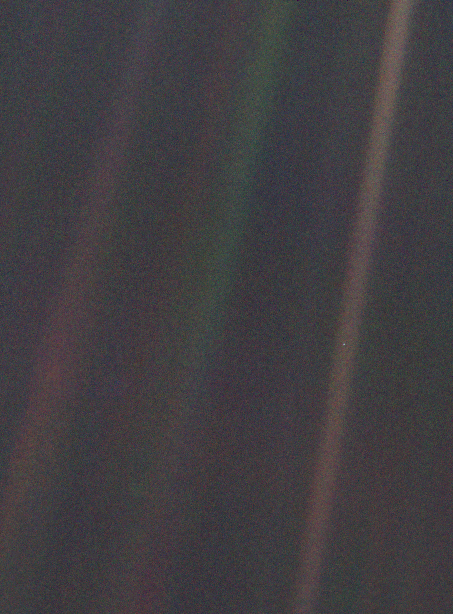
In February of 1990, the unmanned Voyager 1 spacecraft had finished its primary mission of exploring the solar system (it had been launched in 1977) and it was rocketing out of the range of our communication technology at 64,000 km/h (40k mph). 6 billion kilometers away (well past Pluto) it was  further from Earth than anything else we humans had ever built. Realizing a unique opportunity, Carl Sagan requested that NASA turn the camera on the Voyager around and take a snapshot of planet Earth. This is the resulting photograph:

Photo of Planet Earth from 6 billion kilometers away. NASA, February 14, 1990.

Earth is the "Pale Blue Dot" on the right hand side of the photo, sitting in the right-most "beam of sunlight"  (which is actually an artifact of the camera). Click here if you need a hint identifying our planet.

This simple image immediately changes your view on the human condition. As Sagan writes:
From this distant vantage point, the Earth might not seem of any particular interest. But for us, it's different. Consider again that dot. That's here. That's home. That's us. On it everyone you love, everyone you know, everyone you ever heard of, every human being who ever was, lived out their lives. The aggregate of our joy and suffering, thousands of confident religions, ideologies, and economic doctrines, every hunter and forager, every hero and coward, every creator and destroyer of civilization, every king and peasant, every young couple in love, every mother and father, hopeful child, inventor and explorer, every teacher of morals, every corrupt politician, every "superstar," every "supreme leader," every saint and sinner in the history of our species lived there – on a mote of dust suspended in a sunbeam. 
The Earth is a very small stage in a vast cosmic arena. Think of the rivers of blood spilled by all those generals and emperors so that in glory and triumph they could become the momentary masters of a fraction of a dot. Think of the endless cruelties visited by the inhabitants of one corner of this pixel on the scarcely distinguishable inhabitants of some other corner. How frequent their misunderstandings, how eager they are to kill one another, how fervent their hatreds. Our posturings, our imagined self-importance, the delusion that we have some privileged position in the universe, are challenged by this point of pale light. Our planet is a lonely speck in the great enveloping cosmic dark. In our obscurity – in all this vastness – there is no hint that help will come from elsewhere to save us from ourselves. The Earth is the only world known, so far, to harbor life. There is nowhere else, at least in the near future, to which our species could migrate. Visit, yes. Settle, not yet. Like it or not, for the moment, the Earth is where we make our stand. It has been said that astronomy is a humbling and character-building experience. There is perhaps no better demonstration of the folly of human conceits than this distant image of our tiny world. To me, it underscores our responsibility to deal more kindly with one another and to preserve and cherish the pale blue dot, the only home we've ever known. 
—Carl Sagan, Pale Blue Dot: A Vision of the Human Future in Space, 1997 reprint, pp. xv–xvi

For more (albeit closer) pivotal images of Earth from space, see this earlier post.

12.19.2012

If scientists had a Book of Psalms, it would be this book

While wandering through the Princeton bookstore, I stumbled upon this gem. The Oxford Book of Modern Science Writing by Richard Dawkins will become a treasure of the scientific community. Dawkins gathers 83 choice writing excerpts from the "Greats" of scientific writing (e.g. Pinker, Diamond, Turing, Einstein, Sagan, Penrose, Greene, Hawking, Chandrasekhar, Sacks, Oppenheimer, Wilson, Carson, Dyson, Snow... the whole list is here). The excerpts are each short (a few pages) but masterfully chosen, and Dawkins provides a brief discussion of each writer and their style before presenting the text.  The selected excerpts discuss many of the central philosophical questions/insights of science, as well as many of its key contributions -- so readers are educated about actual science in addition to seeing how to write about it beautifully.

The book is thick, and I haven't finished it myself, but I can't recommend it enough for anyone who considers themselves a scientist.  If science were art, this text would be like a distillation of the best masterworks from the world's best museums into a potent liquor that makes you feel guilty when you read from it because it is so rich and amazing -- representing much of humanity's collective accomplishments -- and undeservingly, you're still just sitting on your couch.

If you're looking for a holiday gift for a scientist, I would recommend this. Or if you're a scientist whose annoyed that your loved ones didn't buy you this book for the holidays, you can read a lot of it for free on google here.

An aside: If I ever get the chance, I hope to lead a seminar/clinic for phd students on scientific communication.  I think this book on writing will round out the curriculum alongside Tufte's book on data display and Baron's book on communicating verbally.

11.05.2012

Sexism in science persists, it is unacceptable and female mentors exhibit a substantially larger bias than male mentors

This is a recent, elegant and upsetting PNAS paper:

Science faculty’s subtle gender biases favor male students
Corinne A. Moss-Racusin, John F. Dovidio, Victoria L. Brescoll, Mark J. Grahama, and Jo Handelsman
Abstract: Despite efforts to recruit and retain more women, a stark gender disparity persists within academic science. Abundant research has demonstrated gender bias in many demographic groups, but has yet to experimentally investigate whether science faculty exhibit a bias against female students that could contribute to the gender disparity in academic science. In a randomized double-blind study (n = 127), science faculty from research-intensive universities rated the application materials of a student—who was randomly assigned either a male or female name—for a laboratory manager position. Faculty participants rated the male applicant as significantly more competent and hireable than the (identical) female applicant. These participants also selected a higher starting salary and offered more career mentoring to the male applicant. The gender of the faculty participants did not affect responses, such that female and male faculty were equally likely to exhibit bias against the female student. Mediation analyses indicated that the female student was less likely to be hired because she was viewed as less competent. We also assessed faculty participants’ preexisting subtle bias against women using a standard instrument and found that preexisting subtle bias against women played a moder- ating role, such that subtle bias against women was associated with less support for the female student, but was unrelated to reactions to the male student. These results suggest that interventions addressing faculty gender bias might advance the goal of increasing the participation of women in science.
The authors construct a fake job application for a hypothetical undergraduate student who is applying to work as a scientific technician/lab manager in a laboratory (this is a common stepping-stone to entering a doctoral program and becoming a PhD researcher). The authors randomly assign a male or female name to the applicant and distribute the application to principle investigators (PhD scientists who run real labs), asking them to score the applicant on a variety of metrics such as "competence" and "hireability." The only difference between applications is the gender of the student. The results are unambiguous:

Click to enlarge

It is possible that one could construct an explanation for why researchers would mentor male students more, without invoking sexism -- eg. perhaps if the scientist believes a female student is more likely to leave the field, they will feel like there is less personal reward for spending time mentoring female students. But (and this is where I congratulate the authors for a well-designed experiment) there is no way that differences in "competence" scores can be explained without sexism.

The authors then ask these principle investigators how much they would be willing to pay the applicant to work in their lab:

Click to enlarge

The authors write: 
Finally, using a previously validated scale, we also measured how much faculty participants liked the student (see SI Materials and Methods). In keeping with a large body of literature, faculty participants reported liking the female (mean = 4.35, SD = 0.93) more than the male student [(mean = 3.91, SD = 0.1.08), t(125) = −2.44, < 0.05]. However, consistent with this previous literature, liking the female student more than the male student did not translate into positive perceptions of her composite competence or material outcomes in the form of a job offer, an equitable salary, or valuable career mentoring.
Every teacher, research and mentor in the sciences should read the paper (open access here) and do some soul-searching, asking themselves if they consciously or subconsciously discriminate against female students, employees in the lab or colleagues.  In addition, I also think we all have the responsibility to keep one another honest and to make one another aware of situations and decisions when we might mistakenly judge our students, employees or peers based on their sex and not on their scientific merit.

Overall, this paper is carefully designed and convincing with writing that is thoughtful and readable.  Just a few comments before proceeding:
  1. The title of the paper describes the results as a "subtle" bias. But as my fiance (a PhD) points out, if effects of this size were found in any other context, they would held up as "big" effects.  I think the use of the word "subtle" is a bit confusing, since I think the authors are referring to the bias being subconscious, rather than referring to the magnitude of the bias (which is not subtle).
  2. Even if these biases are subconscious, they are still sexist. I understand why the authors don't use this language in a published paper, but in discussing these results in the context of our own conduct, it seems important to not shy away from what is really going on. Describing these results as a subconscious bias, rather than sexism, may make them seem more excusable.
  3. The central contribution of the paper is to simply point out what is going on.  Once we are aware of our own biases, especially if they are subconscious, we can make a conscious effort to correct them. But in addition to each of us reflecting on our own actions, there are some easy institutional mechanisms that can be developed to help us avoid these biases. For example, universities could make it easy for scientists to receive job applications through an electronic system that automatically double-blinds the applicant.  (Many peer-reviewed journals do this when sending papers out to referees.)  Unfortunately, it is harder to protect students and researchers in day-to-day activities, so if sexist treatment persists even after the hiring process, this will be harder to address. But much more certainly could be done. For example, it should be standard that an oversight committee anonymously surveys students and employees regularly to determine if there is statistical evidence of discrimination within departments or individuals laboratories (which tend to behave a bit like small fiefdoms, with little to no oversight of the principle investigator's behavior towards students/employees).  The NSF and various funding agencies frequently award money to labs for "teaching and mentoring," so they should make these anonymous evaluations and their analysis (or something similar) a requirement for this funding.
The authors are careful to check whether sexism is a strictly male phenomenon (i.e. men faculty discriminating against female students). They do this by constructing this table:

Click to enlarge

The authors find that both male and female mentors exhibit sexism. But the authors do not push the data as far as they could as they make no statements about whether the bias of male mentors is larger or smaller than that of female mentors.  The authors write:
In support of hypothesis B, faculty gender did not affect bias (Table 1). Tests of simple effects (all d < 0.33) indicated that female faculty participants did not rate the female student as more competent [t(62) = 0.06, P = 0.95] or hireable [t(62) = 0.41, P = 0.69] than did male faculty. Female faculty also did not offer more mentoring [t(62) = 0.29, P = 0.77] or a higher salary [t(61) = 1.14, P = 0.26] to the female student than did their male colleagues. In addition, faculty participants’ scientific field, age, and tenure status had no effect (all P < 0.53). Thus, the bias appears pervasive among faculty and is not limited to a certain demographic subgroup.
And later in the discussion:
Our results revealed that both male and female faculty judged a female student to be less competent and less worthy of being hired than an identical male student, and also offered her a smaller starting salary and less career mentoring. Although the differences in ratings may be perceived as modest, the effect sizes were all moderate to large (d = 0.60–0.75). Thus, the current results suggest that subtle gender bias is important to address because it could translate into large real-world dis- advantages in the judgment and treatment of female science students (39). Moreover, our mediation findings shed light on the processes responsible for this bias, suggesting that the female student was less likely to be hired than the male student because she was perceived as less competent. Additionally, moderation results indicated that faculty participants’ preexisting subtle bias against women undermined their perceptions and treatment of the female (but not the male) student, further suggesting that chronic subtle biases may harm women within academic science. Use of a randomized controlled design and established practices from audit study methodology support the ecological validity and educational implications of our findings (SI Materials and Methods). 
It is noteworthy that female faculty members were just as likely as their male colleagues to favor the male student. The fact that faculty members’ bias was independent of their gender, scientific discipline, age, and tenure status suggests that it is likely un- intentional, generated from widespread cultural stereotypes rather than a conscious intention to harm women (17). Additionally, the fact that faculty participants reported liking the fe- male more than the male student further underscores the point that our results likely do not reflect faculty members’ overt hostility toward women. Instead, despite expressing warmth to- ward emerging female scientists, faculty members of both genders appear to be affected by enduring cultural stereotypes about women’s lack of science competence that translate into biases in student evaluation and mentoring.
Now here is a bit that I am adding. Looking at Table 1, it seemed like the bias for female mentors was larger, but it was hard to tell based on the layout of the table (you have to hold the differences in your head since they aren't written down). This caught my attention because its an issue that was raised by Anne Marie-Slaughter's recent Atlantic article, which I had discussed extensively with family and friends.

So I copied the data from Table 1 into Excel, reorganized it and explicitly compared the magnitude of the bias based on the gender of the faculty-mentor. In the first two panels, the column "difference" is the magnitude of the bias in favor of male students. In the bottom panel, I compare these biases and take their difference (a difference-in-differences) to see whether male or female mentors are more biased (a positive number means female faculty are more biased). The last column lists how much larger the bias is for female faculty relative to male faculty.


Both male and female faculty exhibit sexism. But across all four measures, female faculty exhibit a larger bias then male faculty (I don't have the raw data, so I can't know if the difference is statistically significant in this sample -- but, the direction of the bias is clearly consistent across measures).  Without any evidence that the male student has more merit, the female faculty member is on average 15% more biased when it comes to evaluating whether the applicant is competent; and the female faculty member offers the male student an additional $920 in salary on top of the $3,400 extra that the male faculty offered him. Now, I am not trying to point the finger at women faculty to distract from the fact that male faculty are sexist. Discrimination by either group is unacceptable. I am simply trying to highlight one additional point that was skipped over in the original analysis and which Anne Marie-Slaughter argues is an important (but under-discussed) obstacle for professional women.

The findings of this study are important, and they indicate that all of us, men and women alike, should take a cold hard look at our own decisions, behaviors and tendencies. Sexism of this magnitude and scale, among some of the most highly educated members of society is unacceptable. If you observe a colleague who treats their male and female students differently, or if you see that they run a lab full of happy young men and miserable young women, take them aside and ask them what is going on.  It is not easy to call a colleague out on these things, but they would probably rather hear it from you than an internal review board -- and more importantly, we owe it to our students and employees who work hard for us and look up to their mentors for education, guidance and leadership.

It is morally indefensible that sexism of this magnitude persists in our scientific communities and that the young women who are discriminated against suffer at the hands of their teachers and mentors.  Moreover, we all lose out every time that a talented young woman, who would have made scientific discoveries benefitting the world, leaves science because of discrimination.
9.20.2012

The Anthropocene

If I had to make a movie to advertise this blog and also had animation superpowers, this is the video I would make.

7.13.2012

Early images of earth from space

Everyone knows the famous images of earth rise taken from the moon, but I surprised to run across this earlier amazing 1955 image from space. They pieced it together from a bunch of snapshots automatically shot though a pinhole in the side of a rocket as it rotated at its apex and fell back to earth.

Click to enlarge and read description.

Also cool is this first TV image from the space.


For a sense of our progress in extraterrestrial photography, compare these with the incredibly high-res images from the Suomi satellite released earlier this year.

11.13.2011

Empirical evidence that hard work can make the world a better place

Sometimes when it's the weekend and you need a motivational break from furiously analyzing-data-while-writing-two-papers-while-applying-for-jobs-while-refereeing-stuff-and-washing-dishes, a movie on a historical success does the trick.  Here are some of my favorites flavors of inspiration-caffeine [despite their historical inaccuracies...]:

Amazing Grace - ending slavery in the British Empire
(one of my favorite quotes is Edmund Burke on these events)

Ghandhi - liberating India and Pakistan

The Great Debaters - civil rights in the US
(maybe I like this because I met my fiance on our high-school's science olympiad team...)

Invictus - reconciliation in post-apartheid South Africa
(I remembered to post this because I was jogging in my Springbok's jersey!)

7.19.2011

Important questions vs. interesting questions

In a recent conversation over drinks with a colleague, we got into the classic debate of whether researchers should select interesting questions or important questions. There are lots of "research advice" documents out there discussing this tradeoff (eg. this one by Donald Davis, which DRDR recently pointed out), but I don't believe there really is a tradeoff per se.

Here's what I think my opinion is (for now, at least): there are many interesting but un-important questions but there are no important but un-interesting questions.

If a question really is important for society, then it is by definition interesting.  If an important question remains unanswered, it is probably because it is difficult to answer.  But if it really is important, then there will be many people interested in its answer (so long as you can come up with a good one).  Clearly, this means the question is interesting.

I think there are two reasons that important questions sometimes get mistakenly categorized as "uninteresting" by researchers. First, researchers sometimes have a strategic incentive to label a question they do not know how to answer as uninteresting, since it gives them justification for not investigating the problem.  Second, questions may be so difficult to answer that we assume any answer will be unsatisfying and thus uninteresting.  In both these cases, I think we confuse the difficulty of a problem with whether that problem is interesting. 

It's fine with me if some academics want to work on interesting but unimportant questions, I don't see any way to stop this from happening.  But I get angry when researchers thoughtlessly dismiss as uninteresting a question that they are willing to recognize is important.

7.13.2011

Quotes for the discouraged researcher

Research is hard.  And keeping oneself inspired to keep at it is even harder.  These are some favorites that keep me going.  (If these aren't enough, see Xavier Sala-i-Martin's hilarious collection of rejected ideas.)

"Somewhere, something incredible is waiting to be known."
- Carl Sagan

"The significant problems we face cannot be solved at the same level of thinking we were at when we created them."
- Albert Einstein

"I have not failed. I have just found 10,000 ways that won't work."
-Thomas Edison on attempting to make an incandescent light bulb

"Good and bad research take the same amount of time."
- Some economist?
(tell me who if you know). Larry Summers

"If you want to make incremental contributions to the literature in your field — let us say, if you want to generalize an existence theorem by relaxing the condition of semi-strict quasi-concavity to one of mere hemi-demi-proper pseudoconcavity — then stick to the technical journals. If you want to change your field in more fundamental ways, then obtain your primary motivation from life, and use it to look for fundamental shortcomings of previous thinking in the field."
- Avinash Dixit describing Thomas Schelling after he won the Nobel Prize
(I owe this one to Matt Notowidigdo)

"He well knows what snares are spread about his path, from personal animosity... and possibly from popular delusion.  But he has put to hazard his ease, his security, his interests, his power, even his... popularity.... He is traduced and abused for his supposed motives.  He will remember that obloquy is a necessary ingredient in the composition of all true glory: he will remember...that calumny and abuse are essential parts of triumph.... He may live long, he may do much.  But here is the summit.  He never can exceed what he does this day."
-Edmund Burke's eulogy of Charles James Fox for his attack upon the tyranny of the East India Company, House of Commons, December 1, 1783
(I owe this one to JFK)

"Good sense is, of all things among men, the most equally distributed; for every one thinks himself so abundantly provided with it, that those even who are the most difficult to satisfy in everything else, do not usually desire a larger measure of this quality than they already posess. And in this it is not likely that all are mistaken: the conviction is rather to be held as testifying that the power of judging aright and of distinguishing truth from error, which is properly what is called good sense or reason, is by nature equal in all men; and that the diversity of our opinions, consequently, does not arise from some being endowed with a larger share of reason than others, but solely from this, that we conduct our thoughts along different ways, and do not fix our attention on the same objects. For to be possessed of a vigorous mind is not enough; the prime requisite is rightly to apply it. The greatest minds, as they are capable of the highest excellences, are open likewise to the greatest aberrations....
I will not hesitate, however, to avow my belief that it has been my singular good fortune to have very early in life fallen in with certain tracks which have conducted me to considerations and maxims, of which I have formed a method that gives me the means, as I think, of gradually augmenting my knowledge, and of raising it by little and little to the highest point which the mediocrity of my talents and the brief duration of my life will permit me to reach."
-Rene Descartes, Discourse on Method, 1637

6.24.2011

A geological perspective on humanity: comparing human and volcanic CO2 emissions


I think this was my favorite paper this week.  It is both important, thoughtful and amusing (I think the author was trying to be dryly funny; but if not, my apologies).  Most of all, it's slightly mind-blowing.  I don't think my commentary enriches it, so below are simply my favorite quotes from it, with emphasis added. (Main figure at bottom)


Ultrashort summary: In order to emit CO2 at the same rate as humans, we would need Mt. St Helens to erupt violently every 2.5 hrs. 


[Update: Gerlach posted about this article on RealClimate here]
Terry Gerlach
Cascades Volcano Observatory (Emeritus), U.S.Geological Survey,Vancouver,Wash.

The climate change debate has revived and reinforced the belief, widespread among climate skeptics, that volcanoes emit more CO2 than human activities [Gerlach, 2010; Plimer, 2009]. In fact, present-day volcanoes emit relatively modest amounts of CO2, about as much annually as states like Florida, Michigan, and Ohio...

The projected 2010 anthropogenic CO2 emission rate of 35 gigatons per year is 135 times greater than the 0.26-gigaton-per-year preferred estimate for volcanoes....

Volcanic emissions include CO2 from erupting magma and from degassing of unerupted magma beneath volcanoes. Over time, they are a major source for restoring CO2 lost from the atmosphere and oceans by silicate weathering, carbonate depo- sition, and organic carbon burial [Ber- ner, 2004]. Global estimates of the annual present-day CO2 output of the Earth’s degas- sing subaerial and submarine volcanoes range from 0.13 to 0.44 billion metric tons (gigatons) per year [Gerlach, 1991; Allard, 1992; Varekamp et al., 1992; Sano and Wil- liams, 1996; Marty and Tolstikhin, 1998]; the preferred global estimates of the authors of these studies range from 0.15 to 0.26 gigaton per year....

Anthropogenic CO2 emissions—responsible for a projected 35 gigatons of CO2 in 2010 [Friedlingstein et al., 2010]— clearly dwarf all estimates of the annual present-day global volcanic CO2 emission rate. Indeed, volcanoes emit significantly less CO2 than land use changes (3.4 giga- tons per year), light-duty vehicles (3.0 giga- tons per year, mainly cars and pickup trucks), or cement production (1.4 gigatons per year). Instead, volcanic CO2 emissions are comparable in the human realm to the global CO2 emissions from flaring of waste gases (0.20 gigaton per year) or to the CO emissions of about 2 dozen full-capacity 1000-megawatt coal-fired power stations (0.22 gigaton per year), the latter of which constitute about 2% of the world’s coal-fired electricity-generating capacity. More meaningful, perhaps, are the comparable annual CO2 emissions of nations such as Pakistan (0.18 gigaton), Kazakhstan (0.25 gigaton), Poland (0.31 gigaton), and South Africa (0.44 gigaton)."

The nearly 9-hour duration of both the Mount St. Helens and Pinatubo paroxysms gives average CO2 emission rates of about 0.001 and 0.006 gigaton per hour, respectively. Intriguingly, the anthropogenic CO2 emission rate of 35 gigatons per year— equivalent to 0.004 gigaton per hour—is similar. So, for a few hours during paroxysms, individual volcanoes may emit about as much or more CO2 than human activities. But volcanic paroxysms are ephemeral, while anthropogenic CO2 is emitted relent- lessly from ubiquitous sources. On average, humanity’s ceaseless emissions release an amount of CO2 comparable to the 0.01 giga- ton of the 1980 Mount St. Helens paroxysm every 2.5 hours...

Several dilemmas arise from the belief that volcanic CO2 emissions exceed the 35-gigaton-per-year anthropogenic CO2 emis- sion. For example, a global volcanic CO2 output exceeding 35 gigatons per year would imply that the annual mass of volcanic CO2 emissions is more than 3 times greater than the likely annual mass of erupted magma (~10.8 gigatons per year [Crisp, 1984])... 
Scaling up all active subaerial volcanoes [to emit the same amount as humanity] evokes a landscape with the equivalent of about 9500 active present-day volcanoes...
Scaling up CO2 releases of volcanic paroxysms to the 35-gigaton anthropogenic CO2 emission level is also revealing. For example, scaling up the 0.05-gigaton CO2 release of the 15 June 1991 Mount Pinatubo paroxysm to the current anthropogenic CO2 emission level requires 700 equivalent paroxysms annually. Similarly, scaling the 0.01-gigaton CO2 release of the 18 May 1980 Mount St. Hel- ens paroxysm requires 3500 equivalent paroxysms annually...


click to enlarge

4.05.2011

What empirical social science should aim for: lessons from physics

I frequently complain that empirical social science is obsessed with estimating parameters (eg. demand elasticities) that are rarely compared or generalized.  This makes it hard (or at least unreliable) to use empirical results in theory and prediction.

Recently, I ran into the paper Thermal Conductivity of the Elements: A Comprehensive Review (1974) by Ho, Powell and Liley (don't ask how). It seems like an excellent example of what we, as empirical social scientists, should be aiming for.

The paper is, as advertised, is a comprehensive review (circa 1974) of a specific class of basic physical parameters.  It takes parameter estimates from a huge number of lab studies and tries to synthesize what was known about a these basic parameters.  For a sense of how much research went into uncovering these basic parameters, the paper has 1626 references (this dwarfs anything I've ever seen in the Journal of Economic Literature).

I think that producing an analog of this figure (for essential variables) should be the "near-term" objective of empirical social scientists:

Click to enlarge

Each number denotes the results of a different study.  Note the dark black curve of "Recommended" values that can only be stated with confidence following such a meta-analysis.  How much work went into this single figure of a single parameter? The paper tabulates and summarizes every paper is uses, here's one of the pages the describes the studies from this figure. (The last entry on this page is numbered "190", but it's not the last page in the multi-page table.)

Click to enlarge
One thing that's so impressive about this review is that its not just about copper.  It has a similarly in-depth study of each element. For example, tungsten:

Click to enlarge

One thing that jumps out of this figure is the range of estimates produced by individual studies. Even in the laboratory sciences, it's hard to produce a perfect experiment.  If any one of the estimates above was taken as "perfect," it might produce a very distorted picture of reality.  In economics (the social science I know best), such experimental repetition is discouraged in favor of completely fresh (and clever) studies of novel phenomena. While this setup produces studies that are more entertaining in a seminar, I don't think these incentives are optimal for our science in the long-run.

Finally, its worth noting that it took a lot of hard work by many scientists to obtain the basic parameters pictured above (see the paper for many more).  In social science, where we didn't figure out how to reliably identify parameters in real or quasi-experiments until a few decades ago, we'll need to swallow our pride and recognize that we have a lot of catching up to do. (For example, note that Holland's paper popularizing Rubin's model was published in 1986, more than ten years after this review paper was published.)  I think that if we're honest with ourselves, most of the parameters in social science (besides, maybe, the wage returns to schooling...) are understood about as well as the thermal conductivity of erbium was in 1974.  Following Ho et al., most of our current parameter estimates should probably be explicitly termed "Provisional":

Click to enlarge

2.01.2011

What it means to be in a nondemocratic developing country


Like I assume most of the people who read this blog, I've been watching events unfold in Egypt with a mix of (mostly) hope and (some) worry. Ignoring for the moment possible outcome trajectories, the specifics of what's been going on, the response from other countries, and everything else, I think it's interesting to focus for a second on why and how Egypt got here:
"... a carnival atmosphere descended on the square, where vendors offered food at discount prices and protesters posed for pictures in front of tanks scrawled with slogans like, '30 years of humiliation and poverty.'"
That's from an online NY Times article from yesterday that's been getting continuously updated (and now no longer shows the original quote). The set of events that have to go down to bring about the kind of social unrest we're seeing in Egypt aren't trivial. People routinely toss around the idea of "revolution" when discussing topics like a change in US political party or new regulations (e.g., of gun control, carbon taxation, health care...) but the costs of revolution, in particular in terms of the uncertainty of its outcome, are huge. So I think it bears thinking about for a second:

30 YEARS of humiliation and poverty. Notoriously brutal secret police. Elite capture. Enough frustration to push your way across a bridge guarded by hundreds of cops willing to turn a water cannon on you.

We often talk about development, its constraints, and the various political, economic, and historical forces which result in countries being "developed" or not. Sometimes those conversations can get very abstract. It's worth remembering that being in a typically underdeveloped, undemocratic country means dealing on a day to day basis with issues so debilitating and frustrating that you're motivated to spray paint your grievances on the side of a tank.

*Note: the graffiti on the side of the tank says "Down with Mubarak," and comes from Ramy Raoof's flickr stream, here.

1.27.2011

Histories of Numerical Climate Models

Meteorology Project, 
Institute for Advanced Study, Princeton, 1952. 
Left to right: Jule Charney, MANIAC I, Norman Phillips, 
Glenn Lewis, N. Gilbarg, George Platzman.
I was recently doing some background reading on the history of general circulation models (GCMS) for a paper and thought I'd share two of the nice histories I found.  The first is one that I've shared with many colleagues, both for information and for inspiration:

General Circulation Models of Climate
ABSTRACT: The climate system is too complex for the human brain to grasp with simple insight. No scientist managed to devise a page of equations that explained the global atmosphere's operations. With the coming of digital computers in the 1950s, a small American team set out to model the atmosphere as an array of thousands of numbers. The work spread during the 1960s as computer modelers began to make decent short-range predictions of regional weather. Modeling long-term climate change for the entire planet, however, was held back by lack of computer power, ignorance of key processes such as cloud formation, inability to calculate the crucial ocean circulation, and insufficient data on the world's actual climate. By the mid 1970s, enough had been done to overcome these deficiencies so that Syukuro Manabe could make a quite convincing calculation. He reported that the Earth's average temperature should rise a few degrees if the level of carbon dioxide gas in the atmosphere doubled. This was confirmed in the following decade by increasingly realistic models. Skeptics dismissed them all, pointing to dubious technical features and the failure of models to match some kinds of data. By the late 1990s these problems were largely resolved, and most experts found the predictions of overall global warming plausible. Yet modelers could not be sure that the real climate, with features their equations still failed to represent, would not produce some big surprise.
And here is one of my favorite passages about the birth of the enterprise:
In 1922, the British mathematician and physicist Lewis Fry Richardson published a more complete numerical system for weather prediction. His idea was to divide up a territory into a grid of cells, each with its own set of numbers describing its air pressure, temperature, and the like, as measured at a given hour. He would then solve the equations that told how air behaved (using a method that mathematicians called finite difference solutions of differential equations). He could calculate wind speed and direction, for example, from the difference in pressure between two adjacent cells. These techniques were basically what computer modelers would eventually employ. Richardson used simplified versions of Bjerknes's "primitive equations," reducing the necessary arithmetic computations to a level where working out solutions by hand seemed feasible. Even so, "the scheme is complicated," he admitted, "because the atmosphere itself is complicated."  
The number of required computations was so great that Richardson scarcely hoped his idea could lead to practical weather forecasting. Even if someone assembled a "forecast-factory" employing tens of thousands of clerks with mechanical calculators, he doubted they would be able to compute weather faster than it actually happens. But if he could make a model of a typical weather pattern, it could show meteorologists how the weather worked. 
So Richardson attempted to compute how the weather over Western Europe had developed during a single eight-hour period, starting with the data for a day when scientists had coordinated balloon-launchings to measure the atmosphere simultaneously at various levels. The effort cost him six weeks of pencil-work Perhaps never has such a large and significant set of calculations been carried out under more arduous conditions: a convinced pacifist, Richardson had volunteered to serve as an ambulance-driver on the Western Front. He did his arithmetic as a relief from the surroundings of battle chaos and dreadful wounds.
The work ended in complete failure. At the center of Richardson's simulacrum of Europe, the computed barometric pressure climbed far above anything ever observed in the real world. "Perhaps some day in the dim future it will be possible to advance the calculations faster than the weather advances," he wrote wistfully. "But that is a dream." Taking the warning to heart, meteorologists gave up any hope of numerical modeling.

I also found this chapter in a Google-book from a decade ago which had a very nice introduction to some of the early experiments and technical innovations.  It's slightly more technical, but extremely succinct. Less history but maybe more science.

12.17.2010

The rise of the "global environment" as an idea

Google Books Ngram Viewer was released today and is being heralded as a new tool to peer into our collective social conscious (whatever that is).  Basically, Google has scanned zillions of books and created a database of all the words they contain. This data base allows anyone to search for a specific word or phrase and see how often it comes up (as a fraction of all words written in books).

Below are a few graphs that seemed interesting, where I was looking for terms that are often used in academic discussions of the "global environment".  I'm not sure exactly what these tell us, but I think they're fun to look at.  

First, the "global environment" as a pair of words seems to have taken off in the 70's and 80's and then fallen fast after the turn of the millenium.


Words related to global climate change seem to have exploded in the late 80's. But the "greenhouse effect", which actually describes the scientific concept underlying the issue, seems to have peaked early.  Meanwhile "albedo", which is just the scientific term for the reflectivity of the surface (an important parameter in climate dynamics) was moderately popular long before warming was an issue and hasn't grown in usage with the other terms.


If we look at a few terms that describe human developments, "industrialization" grew early and fast, peaking in the 60's and then declining.  Meanwhile the "green revolution" gained notice as it was occurring in the 70's, but never was widely discussed.  "Globalization" and "sustainable development" grew together at almost identical rates in the 80's and 90's.  I think the original synchrony of those two terms in the "collective consciousness" is something quite meaningful, actually, although they diverge later.


Finally, looking at a few abstract terms, we see that the 90's were the time when things started to take off and we can also see the famous switch in usage between "natural capital" and "ecosystem services".


12.10.2010

Challenges for interdisciplinary journals

The American Meteorological Society has a new (1 yr old) journal Weather Climate and Society that is trying to integrate research across several disciplines. For people like myself, the birth of journals like this is comforting because it suggests there is a growing community of researchers interested in applying hard physical science to address social issues.  This is a good thing.  But like everyone trying to do this, they are running into real challenges.  Here are portions of an editorial that resonated with some of my own experiences.  

Jeffrey K. Lazo
....[A] colleague stopped by to ask my advice on a manuscript concept he was considering submitting to Weather, Climate, and Society. He is an outstanding research meteorologist who has been working with a team on models to improve flood warning systems in developing countries. He was interested in demonstrating the economic benefits of the improved warning system and wanted to apply a cost–loss model. Based on his reading of a number of articles in meteorological journals, the cost–loss model was the method of choice for demonstrating economic value.
My initial reaction was largely visceral, because I have a dislike for the cost–loss model. The cost–loss model has been used extensively in the meteorology literature as “the economic model,” but it does not really show up in the economics literature (I should note that my Ph.D. is in economics and, in six years of graduate school, I never once heard of the cost–loss model). A simple search for “cost–loss model” in AMS publications yields 161 hits. A similar search of the economic literature yielded none....
My concern is that the cost–loss model as used in most articles in the meteorology literature does not even begin to capture the full value of economics and build upon the extensive literature in economics on the value of information and decision making under uncertainty. It is simply too simple....
That said, the first issue of Weather, Climate, and Society contained an article based on a theoretical extension of the cost–loss model (Millner 2009; in fact, I recommend reading Millner for an explanation of the cost–loss model). In that article, Millner showed that incorporating a specific behavioral feature in the cost–loss model resulted in net benefit estimates potentially significantly lower than those derived from the basic model. His article demonstrated that behavioral aspects limit the effectiveness of the cost–loss model. I feel this should be read as a demonstration that the meteorological community needs to move beyond the cost–loss model. Building in part on the limitations of the cost–loss model that Millner’s work suggests, I encourage the meteorological community to move beyond the use of that model as the basis for defining economic value....
Weather, Climate, and Society aims to publish “scientific research and analysis on the interactions of weather and climate with society.” This editor’s opinion is that this will largely involve the integration of the social sciences applied to topics of hydrometeorological concern (including weather, water, and climate broadly defined). In light of the prior discussion on cost–loss models, this means we need to better integrate valid economics as economic theory, methods, and practice frame economics with analysis of hydrometeorological issues. More broadly, we need to use appropriate theories and methods from all of the social sciences and not necessarily “accepted” versions of social sciences from the physical sciences perspective.
All of the social sciences have extensive bodies of knowledge they can bring to the study of hydrometeorological issues. Some have a longer history of examining issues related to weather, water, and climate; for instance, sociologists have long studied evacuation decision making during hurricanes. However, for the most part the research and literature is rather thin at the intersection of social and physical sciences relevant to audiences of Weather, Climate, and Society.
Given this landscape, there are definite challenges for the authors, reviewers, and editors for this journal. First, is that most of us (authors, reviewers, and editors) are fairly new to this effort at developing a highly disciplinary but very broadly focused journal combining atmospheric and social sciences. There is a learning curve at this early stage of the journal, because we are all developing and setting standards and expectations. There have been and will continue to be some frustrations as these are clarified. However, as these are clarified and we move forward,Weather, Climate, and Society will be the premier journal for interdisciplinary work “at the interface of weather and/or climate and society.”
There are also difficulties in writing, reviewing, and editing manuscripts for such a highly interdisciplinary journal. For instance, authors, reviewers, and editors for economics journals are almost always economists. I suspect authors, reviewers, and editors for meteorology journals are almost always meteorologists, or at least in general from the “hard” sciences. In addition to meteorologists, authors, reviewers, and editors for Weather, Climate, and Society are from the “harder sciences” such as economists, sociologists, geographers, anthropologists, etc. One challenge for authors will be to maintain high standards for their research while also being able to respond to very diverse (and sometimes divergent) critiques from reviewers with expertise from different disciplines.
For the time being at least, this may make Weather, Climate, and Society the most difficult journal across all American Meteorological Society (AMS) publications to publish in and to be an editor for. However, it may well also make Weather, Climate, and Society the most valuable and dynamic journal in terms of moving the various disciplines forward in new, challenging, and interesting areas of societally relevant research, methods, and applications.
(I hope I cut out enough of it that I'm not infringing on copyrights). 

6.17.2010

Watching soccer and celebrating planetary-scale achievements

I was watching the World Cup live on my laptop during breakfast today when I was struck by the massive achievements underlying this simple activity.

The players in Capetown are 7,800 miles (12,600 km) away from my NYC apartment (as the albatross flies, following the curved surface of the planet: see Google Earth image). Only 200 years ago on a fast clipper ship sailing 16.7 mph, it would have taken 19.5 days for information to travel that distance.  Driving a similar distance non-stop at 60 mph would take 5.4 days.  But now I can watch a goal being scored in almost real time (it only takes light, which is slightly faster than the transmitted signals, 0.042 seconds to travel that distance in a vacuum) while eating a bowl of oatmeal.

Not only have we developed the technology to send these signals around the world, but we have built the infrastructure to carry them, we have developed the legal and institutional machinery necessary to support and organize such massive infrastructure investments, and we have implemented an economic system that rewards individuals for doing all of the above.  Moreover, the information isn't just traveling from Capetown to my breakfast table, but to a few billion breakfast/lunch/dinner tables around the world.

It's easy to get down on humanity when you're focused on our mistakes and shortcomings, but sometimes its worth it to step back and celebrate our achievements.  We've come a long way from where we once were.

5.22.2010

The achievements and under-achievements of our species

A friend sent me this spectacular time lapse video of the space shuttle preparation in an email. if you haven't seen it, you can watch it right here.